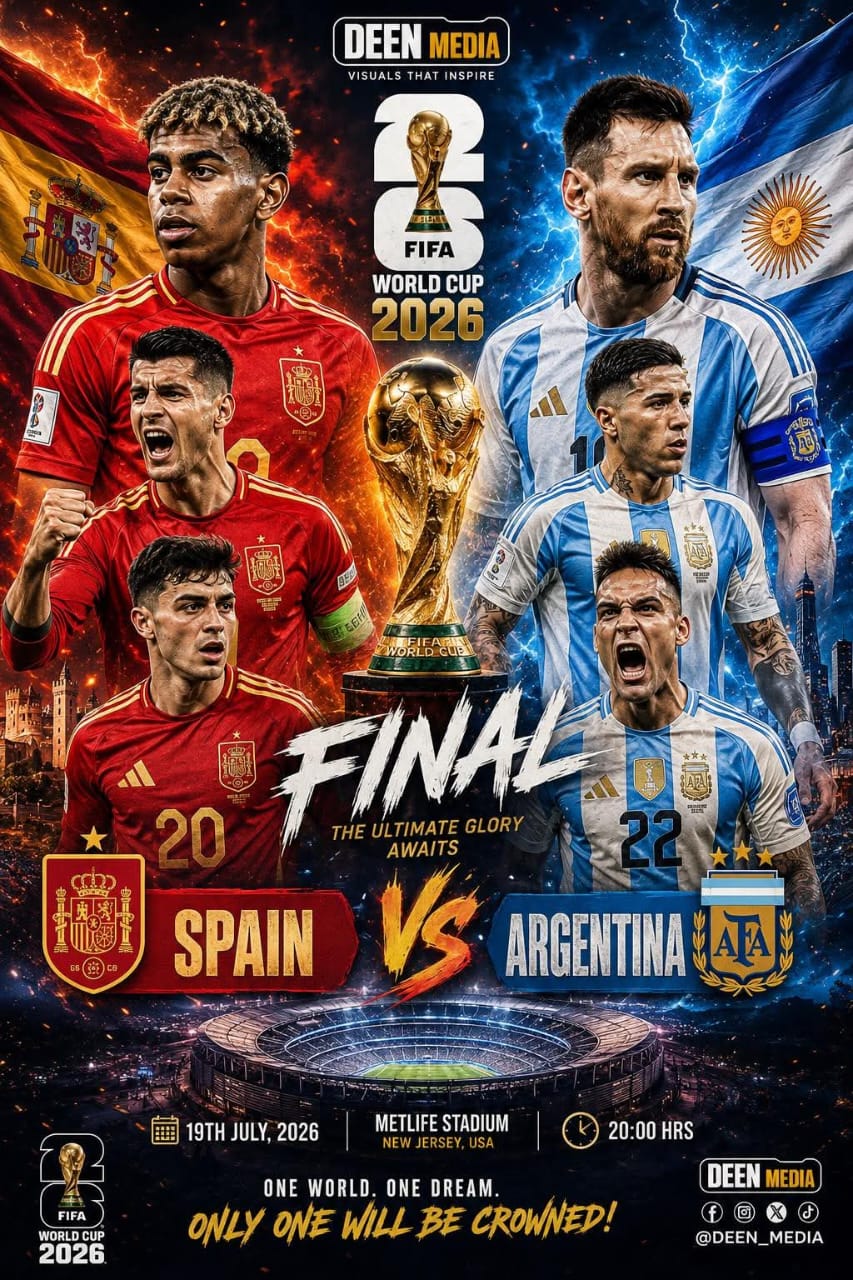
As I write this article, it’s almost eight hours to the Spain v Argentina World Cup final.
Some World Cup finals are remembered for the football. Others are remembered for the stories they tell. Today’s showdown between Spain and Argentina promises to deliver both.
It is a final where history meets destiny, youth meets experience, teacher meets student, and where one era may finally hand over the baton to another. Rarely has football offered such a rich collection of narratives in a single match.
The World’s Two Kings
This is no ordinary final. It pits FIFA’s two highest-ranked nations against each other. The reigning European champions face the reigning South American champions. Both are former World Cup winners.
Both are recognised as global football superpowers. If there were ever a final worthy of crowning the world’s best team, this is it.
From Empire to Equals
There is another historical layer beneath the football. For nearly three centuries, Spain ruled what is now Argentina.
From coloniser and colony… to equals competing on the biggest sporting stage on Earth. History once defined their relationship through power.
Football now defines it through equality. No nation commands the other anymore. Only ninety minutes – or perhaps 120 – will decide who rules world football.
A Story That Began in a Baby Bath
Perhaps no image captures this final better than a photograph taken in Barcelona in 2007.
Lionel Messi was 20 years old, already becoming Barcelona’s brightest star. During a UNICEF charity event, he gently bathed a five-month-old baby named Lamine Yamal.
It was an ordinary charity event. It became an extraordinary piece of football history. Nearly twenty years later, the baby stands on the opposite side of the World Cup final wearing Spain’s colours.
The young man who once held him now leads Argentina. Few stories in sport have unfolded with such breathtaking symmetry.

Twenty Years Later
This tournament marks exactly twenty years since Messi made his World Cup debut. Two decades later, he is still defining matches on football’s biggest stage.
Longevity at the highest level is rare. Remaining decisive after twenty years is almost unprecedented.
The Present Versus the Future
Spain arrive with football’s brightest emerging superstar. Argentina arrive with football’s greatest living legend.
Ironically, despite all the excitement surrounding Lamine Yamal, it is the 39-year-old Messi who has had the greater influence throughout this World Cup.
The veteran has repeatedly rescued Argentina. The teenager has illuminated Spain. Tonight may become football’s greatest symbolic handover – or perhaps the greatest postponement of one.
A Shared Journey Through the Numbers
The numerical parallels between Lionel Messi and Lamine Yamal are striking. Messi made his Barcelona debut wearing No. 30 before entering his first World Cup in Argentina’s No. 19 shirt and later becoming the iconic No. 10.
Yamal began at Barcelona in No. 41, now wears No. 19 for Spain – the same number Messi wore at his first World Cup – and has already inherited Barcelona’s famous No. 10. Their careers may belong to different generations, but even their jersey numbers appear to connect one football era to the next.
Teacher Against Student
Another fascinating subplot unfolds on the benches. Years ago, Spain coach Luis de la Fuente was one of the coaching instructors who helped educate Argentina coach Lionel Scaloni through UEFA’s coaching programmes.
Today, mentor and former student meet for football’s highest honour. The classroom has become the World Cup final.
Two Different Journeys
Spain have cruised through the tournament with remarkable control. Their football has been elegant, balanced and efficient. Argentina have travelled the harder road.
Every knockout match has tested their nerve. Every victory has demanded resilience. Spain arrive fresher. Argentina arrive battle-hardened. History has shown that both roads can produce champions.
Almost Impossible to Separate
History offers no clear favourite. Since their first meeting in 1952: Spain wins: 6. Argentina wins: 6. Draws: 2. Goals scored: Spain 19 Argentina 18.
Even their rivalry refuses to choose a superior side. Their only previous World Cup meeting came in 1966, when Argentina defeated Spain 2–1 in the group stage. Nearly sixty years later, they meet again – for the first time in a World Cup final.
What’s at Stake?
For Lionel Messi, the stakes are enormous. Victory would further strengthen an already extraordinary claim as the greatest footballer in history, proving that even at 39, he could still lead the world’s best team to the summit.
It would be a fitting celebration of twenty years on the World Cup stage and perhaps the perfect closing chapter to his international story.
Defeat, however, would not diminish his legacy. He has already conquered almost every mountain football offers. But it could mark the emotional end of an era, with football’s greatest icon falling just short against the generation destined to replace him.
For Lamine Yamal, the equation is entirely different. Victory would announce, beyond any doubt, that football’s new king has arrived. Winning a World Cup at such a young age would place him in extraordinarily rare company and could become the defining launchpad of a career expected to dominate the next decade.
Defeat would hurt – but perhaps not for long. At his age, time is overwhelmingly on his side. Unlike Messi, Yamal’s story is only beginning. He would almost certainly leave this tournament knowing that more opportunities await.
In many ways, Messi is fighting to preserve a legacy. Yamal is fighting to begin one.
Messi Carries Argentina. Spain Carries Itself
Objectively speaking, however, much of the pre-final narrative has been built around Lionel Messi and Lamine Yamal, but the comparison deserves perspective. Messi remains the undisputed heartbeat of Argentina. Their attack, creativity, leadership and emotional resilience revolve around him in a way unmatched by any other player in this tournament. Spain, by contrast, are not dependent on Lamine Yamal alone.
Their success is rooted in a highly organised collective system in which several players have been equally, if not more, influential. Midfield conductor Rodri dictates the rhythm of play, Pedri provides control, vision and balance in midfield, Pau Cubarsí anchors a disciplined defence, while Lamine Yamal adds creativity and unpredictability in the final third.
Yamal has undoubtedly produced moments of brilliance, but Spain’s march to the final has been driven by its structure and shared responsibility rather than by one individual. For that reason, portraying this final simply as Messi versus Yamal risks overlooking the collective strength that has made Spain arguably the tournament’s most complete team.
My Prediction
On paper, Spain appear the more complete team. They possess greater depth, youthful energy, tactical balance and have enjoyed a smoother path to the final.
Argentina possess something Spain cannot measure—Lionel Messi’s genius, championship resilience and the confidence that comes from surviving adversity.
If Spain score first, they may control the rhythm. If Argentina keep the contest alive deep into the match, Messi could write yet another unforgettable chapter.
Prediction: Spain 2–3 Argentina.
But perhaps the greatest certainty is this: Twenty years after Lionel Messi unknowingly held baby Lamine Yamal in his arms, football has brought them together again – not as child and idol, but as rivals standing at opposite ends of history.
Tonight, one generation defends its throne. The other attempts to inherit it.