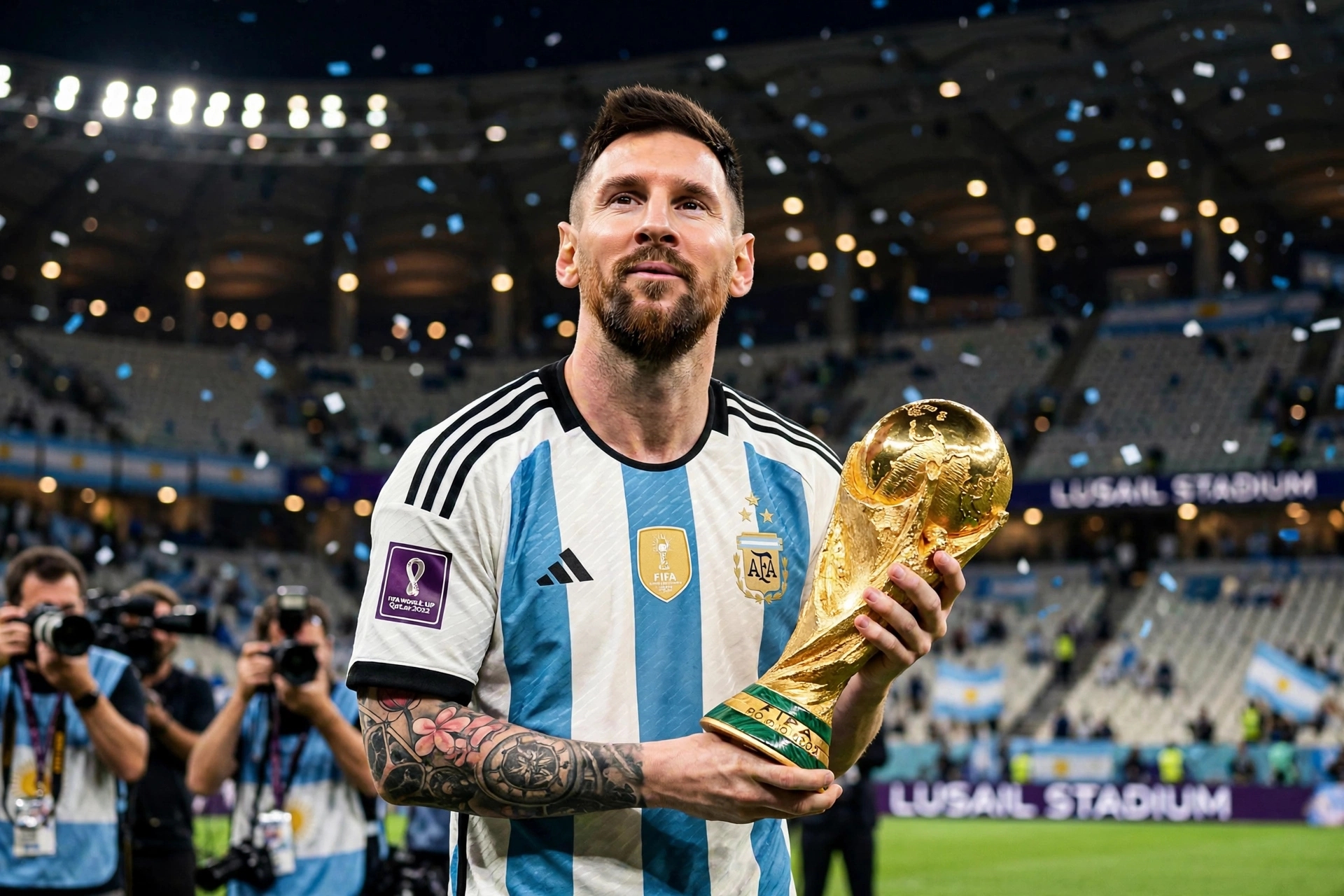
I understand that many people know me for what I have done in journalism, sacred music composition, political analysis, human rights and humanitarian work.
But perhaps only those closest to me know that football has always been one of my great weaknesses. Mention Arsenal or Barcelona, Brazil or Argentina; mention Pelé, Maradona, Ronaldo Nazário, Ronaldinho or Lionel Messi – and suddenly, you have my full attention.
Yet, curiously, in nearly three decades of journalism, sport was never my beat. I never had to cover a football match, interview a star after the final whistle, or file a match report against a newsroom deadline.
As a fan, football has quietly followed me through the different chapters of my life, and for some time I was a fan of Brazil’s Pele until Lionel Messi emerged to occupy a special place in this passion about 20 years ago. This explains why Lionel Messi’s recently announced retirement from international football feels strangely personal to me.
His retirement also helps me understand those tears we saw at the 2026 World Cup. At the time, I thought I understood them: Messi was 39, playing what everyone knew could be his final World Cup, and every match was bringing one of football’s greatest international careers closer to its end.
But there was another story unfolding far away from the stadium. His father, Jorge Messi, the man who had accompanied his son’s football journey since childhood, taken his 13-year-old son to Barcelona and remained Lionel Messi’s agent and closest career companion, was seriously ill. Messi was playing perhaps the most emotionally demanding tournament of his life while his father was fighting for his life.
What makes the story even more poignant is Messi’s later revelation that his father was one of the reasons he was playing the 2026 World Cup at all. After winning in Qatar in 2022, Messi could easily have stopped. He had finally collected the one trophy that had eluded him, and at 35 there was nothing left for him to prove.
But his father wanted one more World Cup. Jorge encouraged him to continue, and Messi did. As his father’s condition deteriorated, Messi hoped he might recover sufficiently to attend the tournament. He kept telling him, in effect: we will reach the final; come and watch me there. Argentina did reach the final. His father never made it.
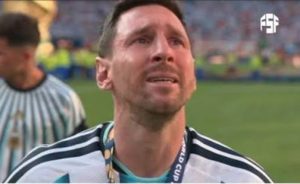
Knowing this now changes the way I remember Messi’s tears. I imagine a 39-year-old man carrying two worlds inside him: Argentina and his father; the football before him and the hospital bed somewhere far away. Yet he still produced an extraordinary tournament. He scored eight goals, took Argentina to another final and finished his World Cup career with a record 21 goals. At an age when most footballers have long retired from international competition, Messi was still deciding matches at the highest level.
I had watched the 35-year-old Messi conquer the world in Qatar, but there were moments when the 39-year-old version fascinated me even more. The legs were understandably slower, but the football brain appeared quicker. He knew when to walk, when to accelerate, when to hold the ball and when to release it. Younger players could run faster; Messi could still see things they could not.
Perhaps that explains why I have followed him for more than 20 years. As I said, before Messi, for me, there was Pelé. For many years, Pelé represented my idea of the greatest footballer. I admired Maradona, of course, and later watched Ronaldo Nazário, Zidane, Ronaldinho and other geniuses, but Pelé occupied that special place.
Then Messi arrived and gradually changed my personal football hierarchy. It was not one spectacular season or one World Cup that did it. It was more than two decades of sustained brilliance – the control, the passing, the dribbling, the vision, the goals and the extraordinary consistency.
The same transition happened with countries. Before Argentina, for me, there was Brazil. Brazil was always my World Cup team. My support for Brazil ended with the end of that wonderful golden generation of Ronaldo Nazário, Rivaldo, Cafu, Roberto Carlos and Ronaldinho.
I loved that Brazilian side and the football it represented. When Brazil lost its samba soccer, my support ended, but I did not immediately replacel with Argentina, either. Argentina became my team much later, and only because of Messi.
At club level, my journey was equally complicated. I used to be a fan of Real Madrid’s Galáctico era, with Ronaldo, Roberto Carlos, Zinedine Zidane and David Beckham. Then Messi happened. His emergence gradually drew me towards Barcelona, and soon I was watching perhaps the most beautiful club football I have experienced.
When Messi left Barcelona for Paris Saint-Germain, my eyes followed him to Paris. When he crossed the Atlantic to join Inter Miami, I followed him to America. Before Messi arrived in the United States, I hardly watched Major League Soccer. Now I regularly follow Inter Miami. The league did not bring me to Messi; Messi brought me to the league.
There is an even stranger contradiction. Like many football fans in Tanzania, I have always been an Arsenal supporter, particularly since Arsène Wenger’s era. Yet whenever Arsenal played Messi’s Barcelona, I found myself supporting Barcelona. I think that says something fundamental about the kind of football that moves me.
For me, football is not primarily about the final score. I love the control, the pass, the dribble, the imagination and the art; the goal comes last. Perhaps that is why I never fell for José Mourinho’s Chelsea or Sir Alex Ferguson’s Manchester United, even when they were dominating English football. I respected their achievements, but winning alone has never been enough to capture my football heart.
Messi gave me something else. I could watch him receive a ball and enjoy what happened before the goal as much as the goal itself: the first touch that eliminated a defender, the slight movement of the body that sent an opponent in the wrong direction, the pass nobody else had seen, or the dribble through a space that appeared not to exist.
This, more than statistics, explains why Messi separated himself from his competitors in my eyes. Others could score spectacular numbers of goals; Messi could turn the entire process of creating one into art.
Eventually, he even made a former Brazil supporter embrace Brazil’ natural rival – Argentina. In fact, I became an Argentina fan in 2022 for one reason: Messi. I believed Qatar would be his final World Cup, and there was one glaring absence from an otherwise extraordinary career.
He had never won the World Cup. I desperately wanted him to leave international football with it. Luckily, he did. But he didn’t retire. When Messi decided to continue with Argentina, I continued with Argentina too.
By 2026, I wanted something even more outrageous. The young Messi didn’t win major trophies. At 34, he won Copa América in 2021, the Finalissima in 2022, the World Cup later that year and Copa América again in 2024. I wanted him to complete five consecutive major international triumphs by winning another World Cup at 39.
Spain stopped that dream in the final, but I cannot regard Messi’s tournament as a failure. Knowing now what was happening to his father, I cherish that performance even more. He was not simply an ageing superstar pursuing another medal; he was a son trying to complete something his father had encouraged him to do.
Then Jorge Messi died. When I heard the news, I immediately wondered whether Lionel would continue playing football much longer. His international retirement announcement followed, and somehow it made sense.
The father who had encouraged him to play one more World Cup was gone. The World Cup itself was over. Messi had given Argentina practically everything a footballer could give his country. What remained to be proved?
Even then, the numbers alone cannot explain my admiration for him. I also love his humility. I have watched great footballers proclaim their own greatness, celebrate themselves and remind the world of what they have achieved. Messi has rarely seemed interested in doing that. Even when journalists give him opportunities to exalt himself, he tends to return to the team and his teammates. He does not need to thump his chest and announce that he is the greatest. He allows the football, the numbers and the trophies to make that argument.
That is perhaps one of the things that distinguishes him, in my eyes, even among the giants with whom he will forever be compared. Pelé was my greatest before him. Maradona was an extraordinary genius. Cristiano Ronaldo has constructed one of the most remarkable careers football has ever seen.
But Messi combined extraordinary achievement with a kind of quietness that I find particularly attractive. He can leave the pitch without telling us what we have just witnessed. The numbers can speak after he has gone.
Now, Argentina want him to return for one final appearance at home so that his people can say goodbye. I think it is a beautiful way to close the curtain. There will be no World Cup to chase, no Copa América to win and no missing medal.
There will simply be Messi, his country and thousands of people who watched him carry their shirt for more than two decades.
I will be watching too, although that match will close something for me as well. Looking back, I have finally realised that I was never really an Argentina supporter. I was a Messi supporter.
Before Argentina, I had Brazil, and my love for Brazil ended with the Ronaldo-Rivaldo-Ronaldinho golden generation. Before Messi, I had Pelé, and for years I thought nobody would take his place in my imagination. Messi somehow changed both.
He took me from Real Madrid’s Galácticos to Barcelona, from Barcelona to Paris, from Paris to Miami, and, most improbably of all, from Brazil to Argentina. For more than 20 years, wherever Lionel Messi went, a part of my football heart followed him.
Argentina will host Benin on October 6, 2026, at the Monumental in Buenos Aires, in what has been confirmed as Lionel Messi’s 208th and final appearance for the national team – a farewell match bringing his extraordinary 21-year international career to a close.
Argentina can now say goodbye to their captain, and I can say goodbye to my Argentina. But as long as Messi continues walking onto a football pitch for Inter Miami or any club, I will continue watching.
After more than two decades, I have finally found the simplest way to explain my football journey: I never followed Messi because of the teams he played for. I followed those teams because Messi played for them.