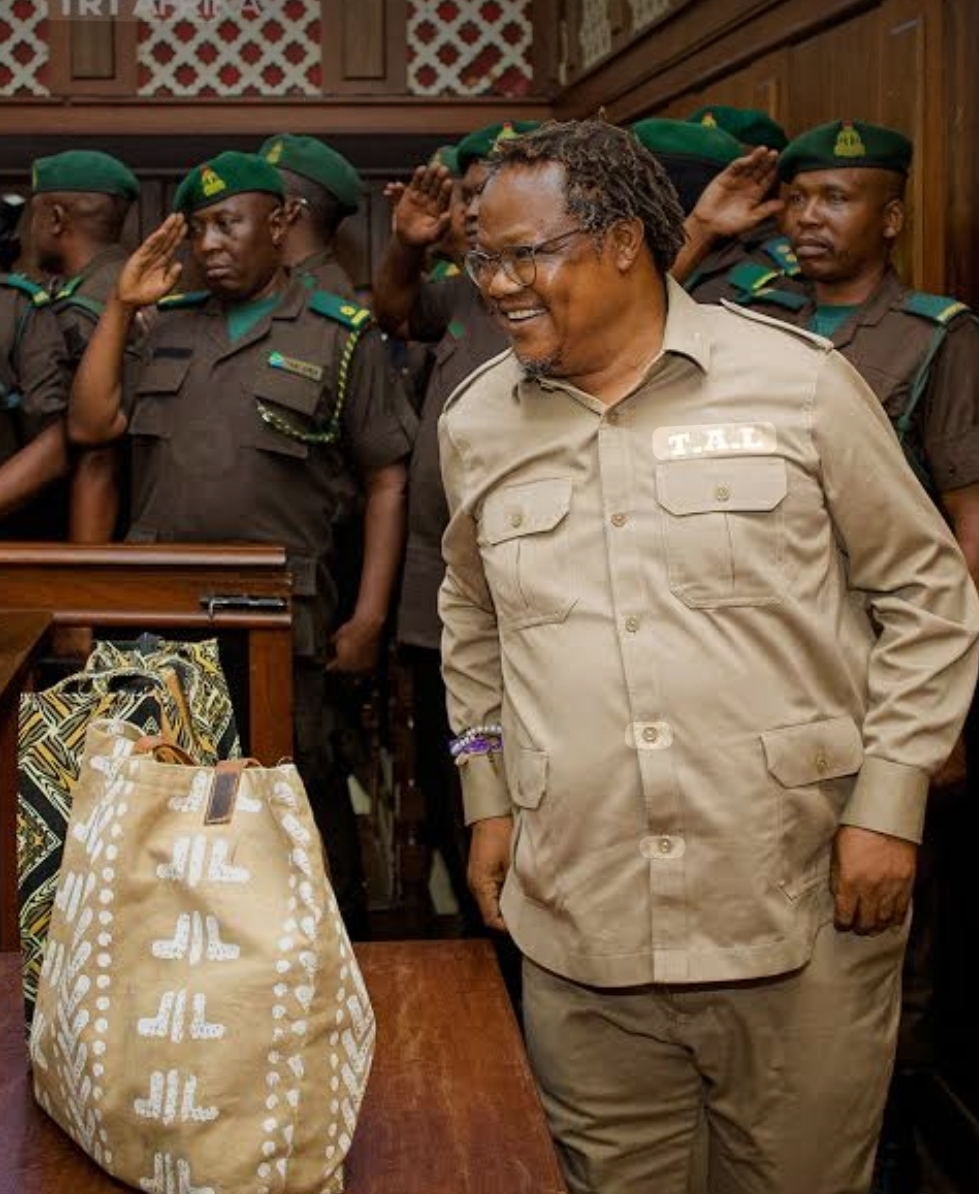
I have known Tundu Lissu personally since 2002, when he was still a relatively young lawyer confronting the government of President Benjamin Mkapa. Long before he became a presidential candidate, a national opposition leader or the defendant in one of Tanzania’s most consequential political trials, confrontation with power was already part of his public character.
But there is another Lissu that political headlines do not easily capture. On 25 December 2017, I visited him at Nairobi Hospital in Kenya, where he was recovering from the horrific shooting in Dodoma three months earlier.
We talked for hours, from around eleven in the morning until nine in the evening, discussing politics, Tanzania, his ordeal and what lay ahead. Of the many things we discussed, one statement has remained with me.
Speaking about the pain he had endured since the shooting, Lissu said he would not wish such suffering upon anybody – not even his enemies. It was an extraordinary statement coming from a man whose body still carried the consequences of an attempt on his life. It revealed something both about the magnitude of the pain and about the person enduring it.
Yet, anyone attempting to understand Tundu Lissu must confront another side of him. Lissu thrives on political polemics. He enjoys argument and counterargument and appears energised by confrontation.
Diplomacy is not his strongest political instrument. When politics becomes a direct contest between himself and another individual, a much harder Lissu can emerge – relentless, uncompromising and, to his opponents, sometimes merciless.
The 2025 battle for CHADEMA’s chairmanship demonstrated this vividly. What could have remained an internal contest over leadership and direction developed into an intensely personal political confrontation between Lissu and Freeman Mbowe, the man who had led the party for 21 years.
Lissu eventually won, receiving 513 of 996 valid votes against Mbowe’s 482, but victory did not automatically heal the divisions exposed during the campaign. The figures themselves told a story: almost half of the delegates had voted for the man Lissu defeated.
He inherited the chairmanship, therefore, together with the responsibility of leading a party whose internal contest had exposed competing loyalties and fundamentally different ideas about how opposition politics should be conducted.
That contradiction is essential to understanding Lissu. He can unite and divide almost simultaneously. His uncompromising language inspires supporters who believe Tanzania’s opposition has spent too long negotiating within political boundaries established by the ruling establishment.
The same language can alienate colleagues who favour organisational discipline, gradual engagement, coalition-building and political accommodation. His accession to the CHADEMA chairmanship therefore represented more than a change of personalities.
Potentially, it represented a change of political method – from the long Mbowe era of organisation-building, coalition-making and tactical engagement towards leadership considerably more comfortable with direct confrontation.
Whether that transformation ultimately strengthens CHADEMA or deepens its internal fractures remains an unsettled question. Lissu’s chairmanship is still young, and Tanzania’s political environment is too fluid for a definitive conclusion. But the difference in style is already unmistakable.
Remarkably, even while standing before the High Court defending himself against a treason charge carrying the gravest possible consequences, the political combatant has remained visible.
His legal defence has also contained the unmistakable language of the politician: constitutional rights, political speech, electoral reform, judicial responsibility and the wider significance of the precedent the judges may establish. The court must determine whether the prosecution has proved the charge against him. Nothing in this analysis attempts to anticipate that judgment. But there is a different question no judgment can answer on its own: What has Tundu Lissu already meant to Tanzanian politics?
Perhaps the answer begins with the paradox visible in that hospital room in Nairobi. The man who told me he would not wish terrible suffering even upon his enemies is also a politician who rarely retreats from confrontation with them. One characteristic does not erase the other. Together, they help explain Tundu Lissu.

The Lawyer Who Challenged Power
His journey began far from the national political stage. Tundu Antiphas Mughwai Lissu was born on 20 January 1968 in Mahambe, in what is now Ikungi District, Singida Region. He attended Mahambe Primary School, Ilboru Secondary School and Galanos Secondary School before studying law at the University of Dar es Salaam.
After obtaining his LL.B, he proceeded to the University of Warwick in Britain for an LL.M. There had even been a brief period as a teacher at Bondeni Secondary School before law became his profession. He worked at D’Souza Chambers and later became a researcher with the Lawyers’ Environmental Action Team, LEAT. He also worked with the World Resources Institute in the United States before returning to LEAT, where he rose to become Director of Research.
These were not incidental jobs preceding politics. They were formative experiences that placed him inside disputes concerning land, mining, natural resources, environmental justice, human rights and the unequal relationship between citizens, corporations and the state.
That professional history matters because Lissu did not arrive in opposition politics as somebody searching for a cause. Before Parliament made him nationally famous, he had already spent years challenging powerful institutions through research, law and public argument.
His work around Tanzania’s mining sector, particularly the controversy surrounding Bulyanhulu, brought him and LEAT into direct confrontation with the Mkapa government. LEAT demanded an independent investigation into allegations concerning artisanal miners during the 1996 Bulyanhulu evictions.
The government and mining interests disputed those allegations. Lissu and fellow lawyer Rugemeleza Nshala subsequently faced sedition proceedings connected with statements demanding an investigation.
Whatever position one adopted on the underlying dispute, something about Lissu was already unmistakable: when he believed power had questions to answer, the fact that the institution answering him was the state did not persuade him to stop asking them.
That history acquired new significance in early September 2017, only days before Lissu was shot. Supporters of President John Magufuli were challenging Lissu’s patriotism, on Facebook, portraying his criticism of the government as evidence that he was somehow against Tanzania’s national interests.
Lissu responded by reaching back into his own record. Long before Magufuli had emerged nationally as the so-called uncompromising defender of Tanzania’s mineral wealth, Lissu argued, he had already been involved in struggles over the country’s mineral resources, mining communities and the terms under which foreign mining interests operated.
After Lissu was shot on 7 September, I returned to those Facebook exchanges while investigating the attack in my Maswali Magumu articles. I quoted his own responses because they provided contemporary evidence of something that political rhetoric was attempting to obscure: his arguments about Tanzania’s minerals had not suddenly appeared as an opportunistic reaction to Magufuli.
They belonged to a much longer record. I also questioned the morality of continuing to revile a man who was lying critically wounded in hospital, regardless of the political disagreements people had with him.
That inquiry soon placed me in confrontation with the government itself. As supporters gathered to pray for Lissu’s recovery, I questioned the hostility directed towards some expressions of solidarity and prayer.
There was an obvious contradiction that troubled me. President Magufuli had himself repeatedly appealed to Tanzanians to pray for him, saying he needed the people’s prayers to perform the enormous responsibilities of his office. If citizens were being encouraged to pray for their President, I asked, why should praying for a badly wounded opposition politician become politically suspect?
I turned that contradiction into the headline of one of my Maswali Magumu articles: “Who Should We Pray For: Magufuli or Lissu?” It was deliberately provocative, but the underlying question was simple. Prayer should not require political permission.
The government’s response to that article – and to my wider questioning of the circumstances surrounding Lissu’s shooting – was brutal. It became part of my own confrontation with the political environment in which Lissu had been attacked, and ultimately part of the story that forced me out of Tanzania.
Lissu’s interest in formal politics had actually appeared even earlier. In Tanzania’s first multiparty general election in 1995, Lissu contested a parliamentary seat through NCCR-Mageuzi but was unsuccessful.
CHADEMA later became his lasting political home, and by the mid-2000s he was closely associated with the party’s legal affairs. In 2010 he entered Parliament as MP for Singida East and retained the seat after the 2015 election.
The Parliament provided an almost perfect arena for his temperament. He became one of the most recognisable opposition parliamentarians of his generation, serving as Opposition Chief Whip and taking prominent roles in debates concerning constitutionalism, executive accountability and the rule of law. His participation in the constitutional-review process and the Constituent Assembly reinforced electoral and constitutional reform as defining elements of his politics.
In early 2017, his fellow lawyers elected him president of the Tanganyika Law Society (TLS). By then, the environmental lawyer I had known in the early 2000s had become one of Tanzania’s most formidable political debaters.
There is no understanding of Lissu without understanding his relationship with argument. He interrogates words, statutes, procedures and inconsistencies and can take an opponent’s proposition apart before returning it as an argument against the person who advanced it.
That ability made him particularly effective in Parliament. But the same characteristic exposes a political limitation. Politics sometimes requires a leader to know when not to say everything he knows, when to leave an opponent an escape route, when yesterday’s adversary may become tomorrow’s coalition partner and when winning an argument may actually make winning the larger political battle more difficult.
Lissu’s instinct generally moves in the opposite direction: confront the proposition, expose the contradiction and push the argument towards its conclusion. That instinct has made him an unusually powerful opposition voice. Whether it makes him an equally effective leader of a broad and internally diverse political organisation is a question his chairmanship is only beginning to answer.
Bullets, Exile And Return
If such a temperament needed an adversarial political environment in which to become fully visible, the presidency of John Magufuli provided one.
Lissu became one of Magufuli’s most outspoken critics. He was repeatedly arrested and faced legal proceedings arising from political statements. To his supporters, those confrontations increasingly transformed him into a symbol of resistance against what they considered shrinking democratic space.
His critics regarded some of his rhetoric as unnecessarily provocative. Whatever interpretation one adopts, confrontation with the state authority became inseparable from his public identity.
Then, on 7 September 2017, that political story changed dramatically. Returning to his residence in Dodoma after the morning parliamentary business, Lissu was attacked by unidentified gunmen. His vehicle was riddled with bullets and he suffered multiple gunshot wounds.
After initial treatment in Tanzania, he was evacuated to Nairobi for specialised care. The identity of those responsible remains unresolved publicly. Lissu has repeatedly alleged political responsibility, but no judicial finding has established who ordered or carried out the attack.
What cannot be disputed is what followed: prolonged treatment, rehabilitation, years outside Tanzania and, eventually, a return to the same political battlefield from which the bullets had almost removed him.
After extended treatment abroad, Lissu returned to Tanzania in 2020 and became CHADEMA’s presidential candidate against Magufuli.
For Lissu and much of the opposition, what happened on 28 October 2020 was hardly an election in the democratic meaning of the word. Activists and opposition supporters mockingly called it uchafuzi.- a Kiswahili play on uchaguzi (election), turning the word into one suggesting the election was spoiled, corrupted or dirtied.
That description reflected the atmosphere surrounding the vote rather than simply dissatisfaction with the official result.
Human-rights organisations documented arrests, intimidation, media restrictions and violence surrounding Tanzania’s 2020 election. Magufuli was officially declared winner with 84 percent against Lissu’s 13 percent, but CHADEMA rejected the results, alleging systematic fraud. That experience became central to Lissu’s later insistence on electoral reform and No Reforms, No Election.
He subsequently left the country again, citing fears for his safety. When he returned in January 2023 after President Samia Suluhu Hassan lifted the restriction on opposition political rallies, he did not undertake a gradual political re-entry. He immediately returned to familiar themes: constitutional reform, electoral reform, political rights and the rules governing competition for state power. Lissu returned as Lissu.
From Mbowe To Lissu
Eventually, however, confrontation moved from the state to his own political home. The struggle between Lissu and Mbowe was consequential precisely because these were not simply two politicians seeking the same office.
They increasingly represented different understandings of how opposition politics should operate. Mbowe’s 21-year leadership had been heavily organisational. Whatever criticisms can legitimately be directed at such a long tenure, Mbowe’s strongest historical claim lies in institution-building: expanding CHADEMA, developing its structures, mobilising resources, building coalitions and helping transform a relatively small opposition party into Tanzania’s principal opposition organisation.
Lissu inherited a robust institution but brought to it a markedly different temperament. Where Mbowe frequently looked for room for negotiation, Lissu is instinctively suspicious of accommodation with power. Where Mbowe could tolerate tactical ambiguity, Lissu prefers explicit positions. Where Mbowe’s politics often seemed to ask, “what space can we create within the circumstances?”, Lissu’s politics more naturally asks, “why should we accept these circumstances in the first place?”
Neither method automatically guarantees political success. They represent different theories of opposition politics. That is why the transition from Mbowe to Lissu may eventually prove historically more significant than merely changing the name beside the title of CHADEMA chairman.
It may represent a transition from organisational and carefully calibrated opposition towards a more confrontational form of politics. The No Reforms, No Election campaign captured that distinction. Its basic proposition was that participating in an electoral system CHADEMA considered fundamentally defective risked legitimising that system.
Supporters saw principle and courage. Critics saw enormous strategic risk. The dispute eventually became entangled with the criminal proceedings now before the High Court, where Lissu faces a treason charge arising from statements associated with his political campaign.
The prosecution alleges that his words and conduct satisfy the legal ingredients of treason; Lissu disputes that interpretation. The prosecution called 17 witnesses and Lissu called five defence witnesses, including himself. The evidence stage closed last week and the parties have proceeded to final submissions since today. The legal conclusion belongs entirely to the judges.
The Politician In The Dock
Yet, the trial itself illustrates the unusual fusion of lawyer and politician that has characterised Lissu for decades. Even when his personal liberty and future are at stake, he has continued to place his defence inside a broader political and constitutional argument.
In his final submissions on Wednesday, he addressed not only the interpretation of the evidence against him but also political speech, constitutional rights, judicial responsibility and the precedent the eventual judgment may establish.
It is classic Lissu: a defendant arguing law, a lawyer arguing politics and a politician addressing history. One may admire that instinct or question its strategic wisdom, but it is difficult to deny its consistency.
The young lawyer confronting the Mkapa government, the MP confronting Jakaya Kikwete and John Magufuli, the challenger confronting Mbowe and the defendant confronting the prosecution are separated by decades, circumstances and vastly different stakes, but the underlying political personality remains recognisable.
This consistency helps explain why Lissu can unite and divide almost simultaneously. He has inspired an exceptionally committed following. To many supporters, his willingness to endure arrests, prosecutions, physical injury, exile and political isolation demonstrates unusual commitment to his convictions.
But intensity produces an opposite reaction. The more strongly some people identify with him, the more strongly others react against him. That becomes particularly consequential now that he leads an organisation rather than merely operating as one of its most powerful voices.
A political movement may benefit enormously from a warrior; a political party needs something more complicated. It needs the warrior, negotiator, administrator, reconciler, strategist and coalition-builder, sometimes within the same person.
Personal courage and political strategy are not synonyms. Few reasonable accounts of Lissu’s career can ignore the risks he has endured, but political leadership must ultimately be judged through more than endurance.
The questions confronting his chairmanship are, therefore, larger than whether he can inspire a crowd or defeat an opponent in debate.
Can confrontation produce institutional change? Can uncompromising rhetoric enlarge a movement beyond those already persuaded? Can a leader challenge a powerful ruling establishment while preserving his own organisation sufficiently to continue the struggle? Can he reconcile internal opponents without requiring their political surrender? Can he convert personal popularity into durable organisational strength? Can he maintain the enthusiasm of those who regard compromise as surrender while recovering the confidence of those within CHADEMA who emerged from the leadership contest bruised, alienated or silent?
These questions will help determine whether Lissu’s political style becomes a new source of strength for CHADEMA or a source of continuing internal fracture.
His Legacy Is An Argument
These questions also lead to the larger question of legacy. With Freeman Mbowe, the answer is comparatively straightforward. His central legacy is the political institution he spent decades helping to build – CHADEMA.
With Tundu Lissu, the answer is different. His legacy is not primarily an institution. It is an argument. For more than two decades, Lissu has insisted that power must explain itself.
As an environmental lawyer, the argument concerned land, mining, communities and state responsibility. As a human-rights advocate, it concerned ordinary citizens facing institutions far more powerful than themselves. As CHADEMA’s lawyer, it concerned political rights. As an MP and Opposition Chief Whip, it concerned executive power and parliamentary accountability.
During the constitutional process, it concerned the architecture of the state. As president of the Tanganyika Law Society, it concerned law and institutional independence. As a presidential candidate, it concerned elections. As chairman of CHADEMA, it concerns whether an opposition party should participate in political processes whose rules it considers fundamentally unfair.
And today, as a defendant, the argument has reached perhaps its most consequential formulation: where does political speech end and criminal treason begin?
The High Court will answer the legal question placed before it. History will answer the larger one. Perhaps Lissu’s lasting significance will ultimately be found precisely in his contradictions.
The man who told me from a Nairobi hospital bed that he would not wish terrible suffering even upon his enemies can be extraordinarily harsh towards his political opponents. The lawyer who believes profoundly in argument can sometimes argue beyond the point at which diplomacy might have achieved more.
The politician capable of bringing thousands behind a cause can simultaneously drive others away from it. The chairman who inherited a party built through decades of careful organisation appears determined to remake its political method around more direct confrontation. The man nearly killed by violence continues confronting political power rather than retreating from it.
One side does not invalidate the other. Together, they explain Tundu Lissu. His greatest political asset may be that he does not easily retreat; his greatest political limitation may ultimately prove to be exactly the same thing.
It is still too early to determine what his chairmanship will ultimately mean for CHADEMA. Mbowe’s long tenure allows history to examine a largely completed leadership era; Lissu’s has barely begun.
It is too early to know whether his confrontational approach will strengthen the party, transform it, deepen its internal fractures or eventually force Tanzania’s political establishment to accommodate demands it has resisted.
It is equally premature to determine whether a political organisation accustomed to Mbowe’s style of careful organisation, coalition-making and tactical engagement can successfully adapt to the more combative politics of his successor.
Tanzania’s political environment remains fluid, and Lissu’s immediate future is itself entangled with a criminal case whose outcome must be left to the judges.
But one conclusion does not depend upon that judgment. Tundu Antiphas Mughwai Lissu has already secured a distinctive place in Tanzania’s multiparty political history. He began as a young lawyer confronting questions of mining, land and state accountability.
He became an environmental and human-rights advocate, CHADEMA legal strategist, MP for Singida East, Opposition Chief Whip, constitutional campaigner, president of the Tanganyika Law Society, survivor of an unresolved assassination attempt, presidential candidate, exile, returning opposition leader and eventually national chairman of CHADEMA.
Now he stands before the High Court accused of treason. Whatever the judges eventually decide will become another chapter in his story; it cannot become the whole story. Courts decide cases. Elections decide office. Political parties decide leadership. Public opinion rises and falls. Legacy is something different.
While Freeman Mbowe’s strongest claim to Tanzania’s political history may ultimately be the opposition institution he helped build, Tundu Lissu’s may be something less tangible, more turbulent and perhaps equally consequential: the refusal to stop arguing with power.
Whether that refusal is enough to lead and hold together a major political party, whether confrontation can ultimately be converted into institutional change, and whether the political combatant can also become the reconciler his divided party may require are questions that remain unanswered.
That is why the story of Tundu Lissu cannot yet be written in the past tense. His legacy is already visible, but its final shape is still being made.