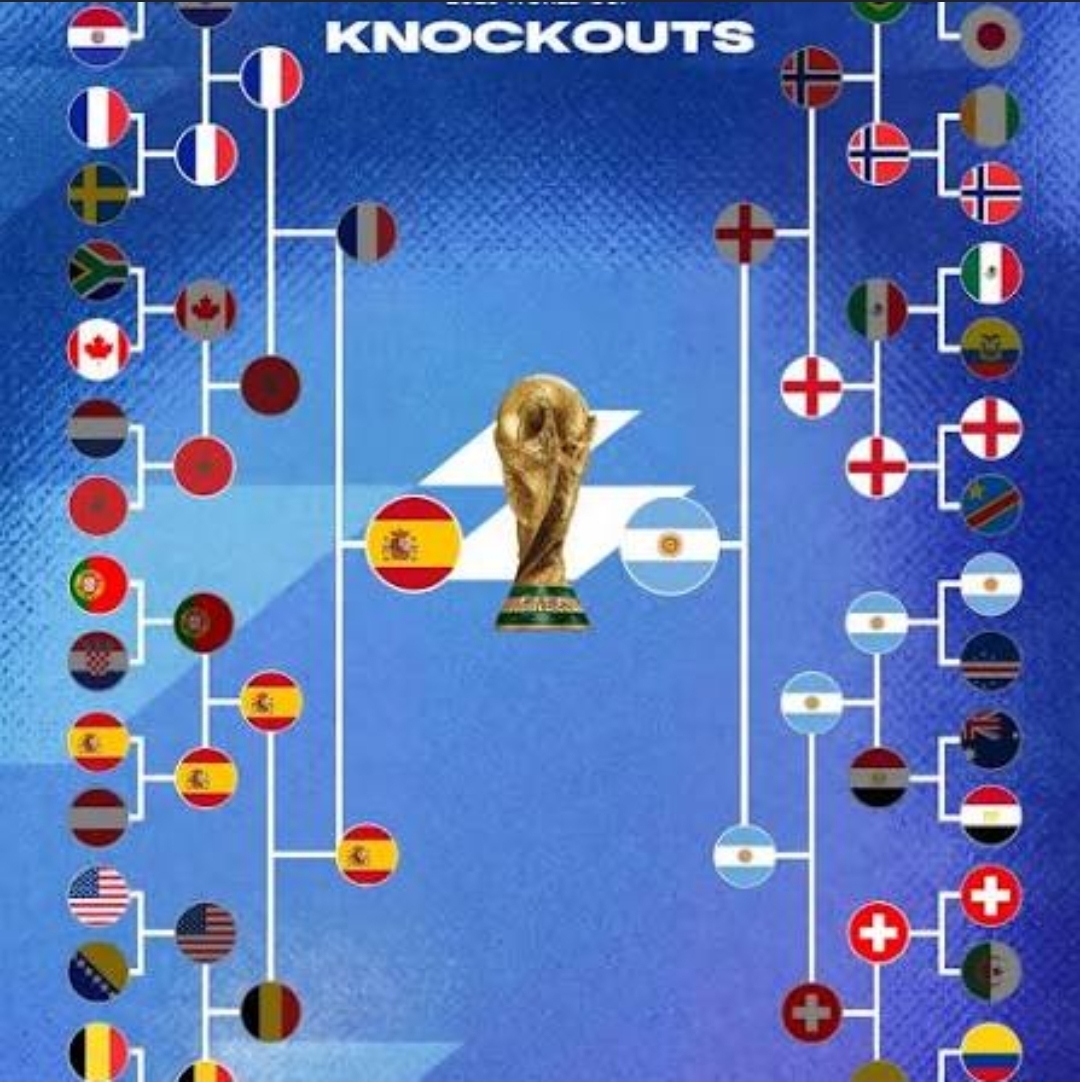
The final some football lovers had hoped to see has finally arrived on the greatest stage possible. Argentina, the reigning world champions and Copa América holders, will face Spain, the reigning European champions, in the 2026 World Cup final.
The two continental champions had been expected to meet in the Finalissima earlier this year, but that match did not materialise. Instead, destiny has elevated the encounter from a ceremonial contest between Europe and South America to the ultimate battle for global supremacy.
The world’s two highest-ranked teams
This is not merely a glamorous final between two famous football nations. According to the last official FIFA ranking before the tournament, Argentina entered the World Cup as the world’s number-one team, with Spain second. The final therefore brings together the two strongest-ranked national teams in world football.
Argentina are seeking their fourth World Cup and attempting to become the first country since Brazil in 1962 to retain the trophy. Spain, world champions in 2010, are pursuing their second title and confirmation that their recent domination of European football has matured into global supremacy.
What the pundits predicted
Before the tournament, Spain were widely regarded as one of the strongest favourites. One major supercomputer forecast placed Spain first, followed by France and England, with Argentina fourth. The reasoning was understandable: Spain possessed youth, technical quality, tactical balance and the confidence of European champions.
Argentina were respected as defending champions, but questions surrounded their ageing core and whether Lionel Messi, at 39, could still carry a team through an expanded and physically demanding World Cup. Both finalists have therefore justified the expectations placed upon them – although Argentina have once again travelled further than some predictive models expected.
Two contrasting football identities
Spain play through control. They want the ball, organise themselves around it and patiently suffocate opponents through passing, movement and positional discipline. Rodri provides authority and balance in midfield, while Lamine Yamal supplies unpredictability, acceleration and imagination from wide areas. Their collective structure allows individual brilliance to emerge without destroying the shape of the team.
Argentina are more emotionally and tactically flexible. They can dominate possession, attack quickly, defend deeply, survive physical battles or turn a match into a contest of character. Their football is less mechanically controlled than Spain’s, but perhaps more adaptable. They combine South American aggression, technical intelligence and an extraordinary capacity to remain alive when a match appears to be escaping them.
Spain’s principal strategy will be to control the rhythm, prevent Argentina from turning the contest into an emotional battle and deny Messi space between midfield and defence. Argentina will seek to disrupt Spain’s passing structure, attack the spaces behind their advanced players and remain close enough for Messi to decide the game with one movement, pass or set piece.

The difficult roads to the final
Neither team simply walked into the final. Spain began with one of the tournament’s greatest shocks – a goalless draw against debutants Cape Verde. They controlled the ball and produced 27 attempts, but Cape Verde’s discipline, courage and outstanding goalkeeping exposed Spain’s difficulty against a compact and determined defence.
Spain recovered, grew stronger and eventually eliminated Austria, Portugal, Belgium and France. Their 2–0 semi-final victory over France was perhaps their most complete performance, combining possession with tactical discipline and defensive authority.
Argentina’s confrontation with Cape Verde was even more dramatic. The defending champions were pushed into extra time before surviving 3–2. Cape Verde equalised twice and came close to producing one of the greatest shocks in World Cup history. Argentina’s relief at the final whistle revealed how seriously they had been tested.
Argentina later overcame Egypt, needed extra time against Switzerland and came from behind to defeat England 2–1 in the semi-final, scoring in the 85th minute and again in stoppage time. Their journey has not always been comfortable, but it has repeatedly demonstrated their refusal to surrender.
Cape Verde therefore occupy a fascinating place in the story of this final. They were the only team to prevent Spain from winning and the team that came closest to dragging Argentina into disaster. Against both giants, Cape Verde proved that reputation alone cannot win a World Cup match.
Their most important strengths
Spain’s greatest weapon is collective control. They have conceded only one goal during the tournament and arrive unbeaten, with six victories and one draw. Their ability to retain possession also protects their defence: opponents cannot attack consistently when they rarely have the ball.
Argentina’s greatest weapon is resilience. They are the tournament’s highest-scoring team, with 19 goals, and have won all seven of their matches. Even when their structure breaks down, their belief does not. They have become specialists in finding decisive moments late in matches.
The strategic question is therefore clear: can Argentina survive Spain’s prolonged control long enough to create decisive moments, or can Spain finally remove the uncertainty and emotional chaos upon which Argentina thrive?
What victory would mean
For Spain, victory would complete one of the most impressive cycles in modern international football. Having conquered Europe, they would become champions of the world and establish a new generation – represented by Yamal – as football’s emerging global standard.
For Argentina, victory would create a dynasty. Winning consecutive World Cups would lift this team beyond the category of a great champion and place it among the most distinguished national sides in football history. It would also reaffirm South America’s ability to resist the growing numerical and financial dominance of European football.
Symbolically, Argentina once again enter the decisive match as the sole surviving representatives of the non-European football world. Spain carry the power of the continent that dominated the latter stages; Argentina carry the resistance of everyone outside it.

Messi’s final mountain
Above every collective storyline stands Lionel Messi. At 39, he has modified his game rather than surrendered to age. He no longer dominates every minute through constant movement. He conserves energy, observes the match and intervenes when the opportunity becomes decisive. Against England, he did not score, but he created both late goals that took Argentina into the final. His two assists increased his World Cup record to 12, alongside his 21 goals in the competition.
Messi has already won the World Cup. He no longer requires this trophy to validate his greatness. But retaining it at 39 would take his international career into almost mythical territory. It would mean leading Argentina to consecutive world titles across two different generations of teammates and completing what may be his final international tournament at the absolute summit.
This final is therefore not simply Messi against Lamine Yamal, although that generational contrast is irresistible. It is the accomplished master against the emerging heir; memory against possibility; the closing chapter of one extraordinary career against the opening chapters of another.
My final assessment
Spain may enter as slight favourites because of their control, defensive stability and tactical cohesion. Argentina, however, possess something that statistics cannot fully measure: an almost irrational certainty that they can survive any situation.
Spain will try to make the final orderly. Argentina will try to make it human – physical, emotional, unpredictable and decided by personality.
The championship may ultimately belong to the team that succeeds in imposing its preferred kind of match. Should Spain control the ball and the spaces, their youthful system could overwhelm Argentina. But should the contest remain unresolved deep into the second half, Argentina’s experience, emotional strength and Messi’s capacity to recognise the decisive moment may become the most powerful forces on the field.
It is the Finalissima that never happened – transformed into something far greater: Europe against South America, the world’s number one against number two, the defending world champions against the European champions, and Lionel Messi standing one victory away from an almost unimaginable farewell.