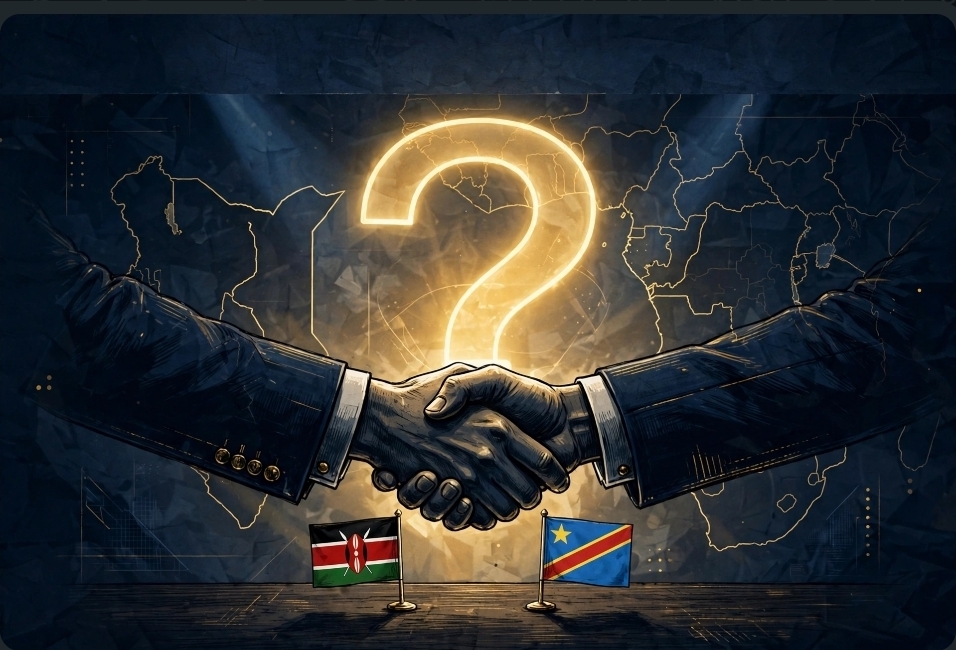
The agreement between Kenyan President William Ruto and his Democratic Republic of Congo counterpart Félix Tshisekedi to restore diplomatic relations is more than a gesture of goodwill. It raises an important question about the future of eastern Congo’s rebellion and the political ambitions of former President Joseph Kabila.
Meeting in Oyo, Republic of the Congo, on 22 November 2026, the two leaders agreed to restore ambassadorial relations and strengthen cooperation through regional institutions. The meeting was facilitated by Congolese President Denis Sassou Nguesso and attended by African Union mediator Faure Gnassingbé.
But why have Nairobi and Kinshasa decided to repair their relationship now? And what does this diplomatic reconciliation mean for Kabila, whose new political-military coalition, the Front pour la Refondation de la Nation (FRN), has become a central player in Congo’s conflict?
To understand the significance, we must revisit December 2023, when former Congolese electoral commission chairman Corneille Nangaa launched the Alliance Fleuve Congo (AFC) in Nairobi. The coalition incorporated the M23 rebellion, which was fighting the Congolese government in the east.
Kinshasa accused Kenya of providing a political platform for forces seeking to destabilise Congo. It recalled its ambassador, while Nairobi maintained that allowing political expression did not amount to supporting rebellion.
Relations deteriorated further as M23 expanded its territorial control. Kenya’s appointment of a consul-general to Goma in 2025, after the city had fallen under rebel control, provoked additional controversy. The hosting of Congolese opposition figures, including Kabila, in Nairobi later that year deepened Kinshasa’s suspicions.
Then came a dramatic development. On 12 October 2026, Kabila announced the creation of the FRN in Goma, formally assuming leadership of a coalition incorporating the AFC’s political and military structures, including forces associated with M23.
The former president, who ruled Congo for 18 years, had moved from being Tshisekedi’s political rival to becoming the political face of an armed challenge to his government.
This transformation complicates Kenya’s position. Nairobi is no longer dealing merely with Congolese opposition politicians operating from its territory. It must consider the implications of its contacts with a former head of state who now leads a movement associated with an active rebellion.
The Oyo agreement therefore presents several possibilities.
First, Tshisekedi may have concluded that prolonged confrontation with Kenya serves little strategic purpose. Congo needs regional cooperation, particularly as the eastern conflict continues to threaten security, trade and humanitarian operations.
Second, Ruto may have recognised that Kenya’s regional diplomatic ambitions require a working relationship with Kinshasa. Kenya cannot credibly present itself as a facilitator of regional stability while maintaining strained relations with one of the principal governments affected by the conflict.
Third, the agreement may create opportunities for diplomatic engagement with actors who have previously operated through Nairobi.
But these possibilities should not be mistaken for established outcomes. There is no confirmed indication that Kenya has agreed to restrict Kabila’s political activities, abandon contacts with FRN-linked figures or change its position on the Congolese opposition.
Nor does the agreement establish that Tshisekedi has softened his position towards Kabila.
Indeed, the two Congolese leaders remain deeply divided. Kabila was sentenced to death in absentia by a Congolese military court in September 2025. He disputes the proceedings. His subsequent leadership of the FRN has intensified the confrontation.
The peace process is equally complicated. Negotiations involving Kinshasa and the rebellion have continued through the Doha framework, but the FRN’s emergence has raised questions about representation, political objectives and the scope of negotiations.
In early November, FRN leaders warned that proposed constitutional changes in Congo could jeopardise the Doha process. Their objections reflected fears that constitutional reform might open the way for Tshisekedi to seek another presidential term.
This introduces another dimension. Is the FRN primarily seeking security arrangements in eastern Congo, or has the rebellion become an instrument for changing the national political order?
And if Kabila’s ambitions extend to replacing Tshisekedi, can a peace process focused largely on eastern Congo’s security problems adequately address the conflict?
For Kenya, the challenge is delicate. It must respect Congo’s sovereignty while preserving its diplomatic credibility and its ability to communicate with different political actors. For Tshisekedi, improved relations with Nairobi may reduce regional friction, but they do not eliminate the armed challenge facing his government.
The people of eastern Congo, meanwhile, have endured years of displacement, insecurity and repeated diplomatic initiatives that have failed to deliver lasting peace.
The Oyo agreement deserves recognition as a constructive diplomatic step. Yet its significance will ultimately depend on what follows: the restoration of ambassadors, improved regional cooperation and tangible progress towards ending the fighting.
Ruto and Tshisekedi have agreed to repair relations between their governments. But the rebellion that helped divide them remains unresolved.
The question is whether their reconciliation will help bring peace to eastern Congo, or merely rearrange the regional political calculations surrounding Joseph Kabila.
That is the question Sauti Kubwa will continue to examine.