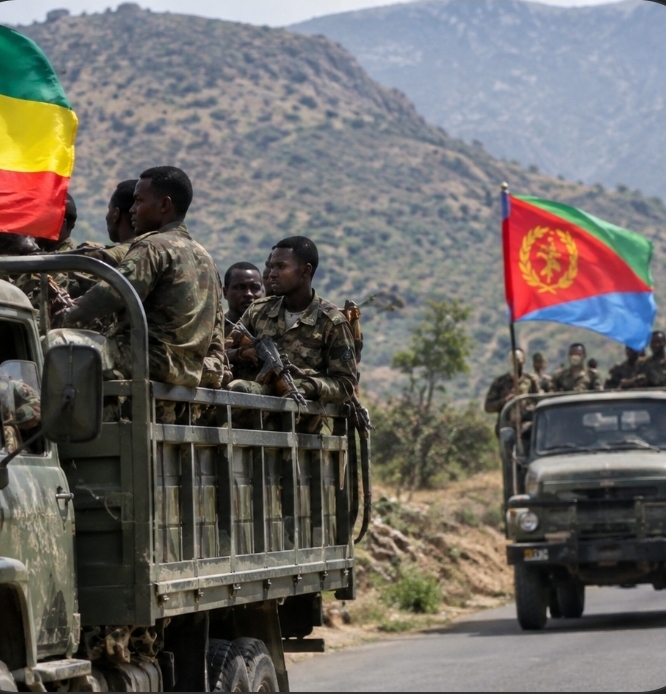
Ethiopia and Eritrea, two neighbouring countries that celebrated a historic reconciliation in 2018, are once again facing the possibility of war. Reports of military deployments along their shared border have raised serious concerns about the stability of the Horn of Africa, a region already struggling with armed conflicts, humanitarian emergencies and political tensions.
On 18 November 2026, Reuters reported that Ethiopian and Eritrean forces had concentrated troops near their common border, particularly around Badme, a town associated with their devastating 1998–2000 war.
Conflict monitors have reported artillery exchanges and possible military clashes. However, direct fighting between the two national armies has not been independently confirmed. Eritrea rejects Ethiopian accusations of aggression.
How did two countries that publicly embraced peace only eight years ago return to such dangerous hostility? What went wrong, and what could happen next?
The history provides important clues. Eritrea gained independence from Ethiopia in 1993, leaving Ethiopia without direct access to the sea. Five years later, the neighbours fought a destructive border war that killed tens of thousands of people. Their relationship remained hostile until Ethiopian Prime Minister Abiy Ahmed and Eritrean President Isaias Afwerki reached a historic peace agreement in 2018. Abiy subsequently received the Nobel Peace Prize.
But their reconciliation faced another test when war erupted in Ethiopia’s Tigray region in 2020. Ethiopian and Eritrean forces fought against the Tigray People’s Liberation Front (TPLF). The conflict caused enormous civilian suffering and ended with the Pretoria agreement in November 2022. Eritrea was not a party to that agreement, and important disputes remained unresolved.
Today, renewed fighting in Tigray has complicated relations between Addis Ababa and Asmara. Ethiopia accuses Eritrea of supporting armed opponents of its government. Eritrea denies the allegations and accuses Ethiopia of preparing aggression against its territory.
Another major disagreement concerns access to the Red Sea. Ethiopia, one of Africa’s most populous countries, considers reliable maritime access essential to its economic development. Eritrea, which controls important Red Sea ports, regards its territorial sovereignty as non-negotiable.
But does Ethiopia’s legitimate need for efficient maritime trade justify any attempt to obtain access without Eritrea’s consent? Could commercial agreements provide a solution without threatening sovereignty? And are both governments prepared to negotiate before military confrontation becomes unavoidable?
The implications extend beyond their borders. Renewed war could disrupt regional trade, increase displacement and complicate security cooperation involving Somalia, Sudan and Djibouti. It could also affect European interests in Red Sea shipping, humanitarian assistance and regional stability.
There are equally important questions for the African Union, IGAD, the United Nations and the European Union. Can these institutions intervene diplomatically before tensions escalate? What lessons have they learned from the failure to resolve outstanding disputes following the Pretoria agreement?
Most importantly, what do ordinary Ethiopians and Eritreans stand to gain from another war after decades of conflict and economic hardship?
The military deployments do not establish that a full interstate war has begun. Nevertheless, the competing accusations, unresolved political disputes and renewed fighting in Tigray make the situation particularly dangerous.
The central question is no longer simply why Ethiopia and Eritrea distrust each other. It is whether their leaders can resolve their disagreements through negotiation before another generation pays the price of war.