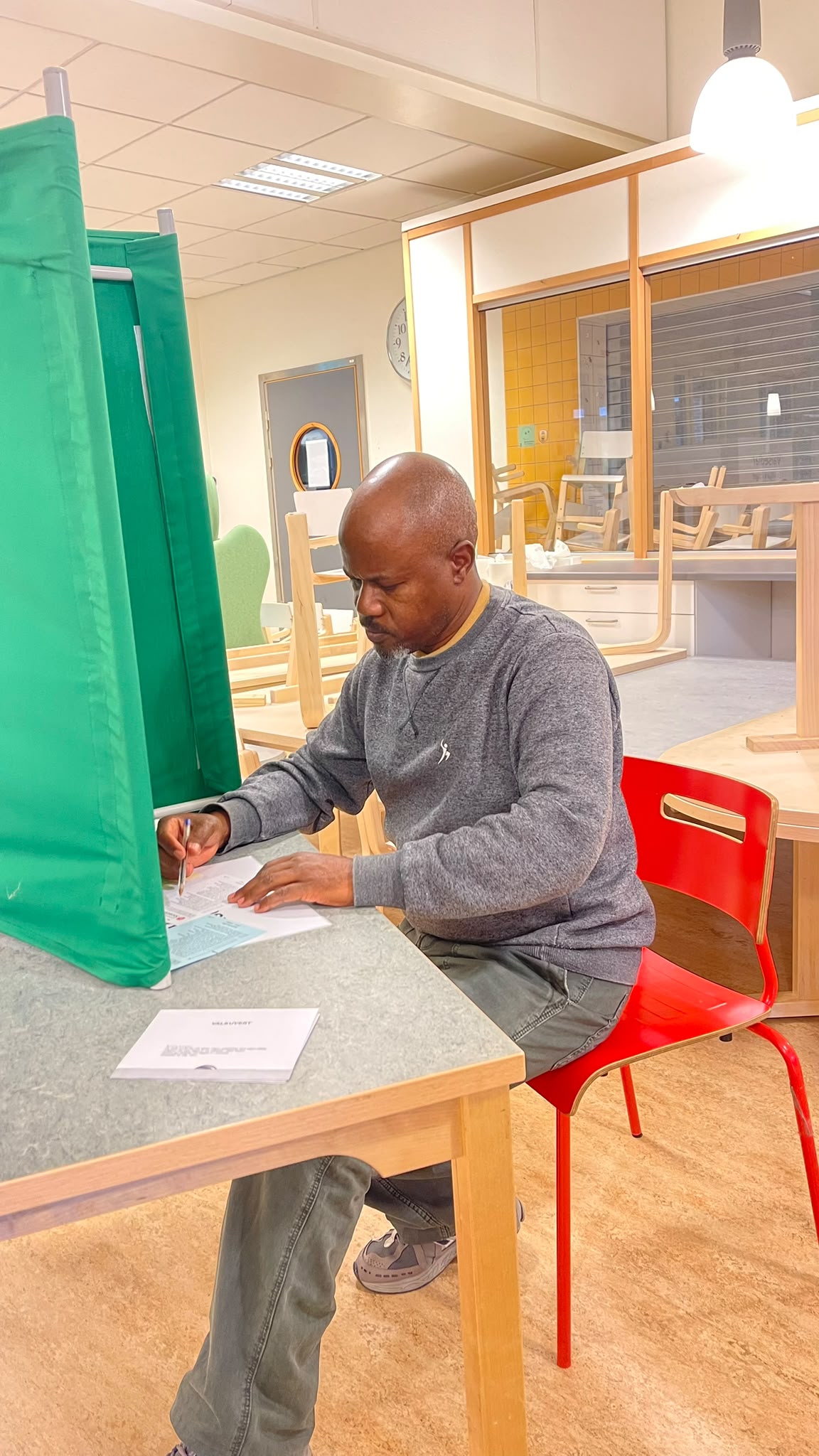
Today, September 13, 2026, I voted in Sweden’s general election.
It was remarkably ordinary. I walked into a polling station, identified myself, made my choices and voted. Nobody wanted to know which party I supported. Nobody intimidated me. Nobody made me wonder whether my ballot would eventually become something different from what I had put into the system.
Yet, as a Tanzanian journalist who has observed elections and politics for nearly three decades, I walked away thinking about home. Why should something so ordinary in Sweden have to become so contentious – and sometimes deadly – in Tanzania?
Sweden itself presents a fascinating contradiction. For the 2026 elections, 415 unique political parties registered to participate at national, regional or municipal level. Of these, 168 registered for the national parliamentary election.
Yet Sweden is not drowning in political chaos. Only eight parties sit in the outgoing Riksdag (Parliament).The national threshold is normally four per cent. Parliament has 349 seats: 310 permanent constituency seats and 39 adjustment seats. Those adjustment seats help make the final composition of Parliament correspond more closely to how Swedes actually voted nationally.
Think about the principle behind that. A party may lose particular constituencies, but millions of votes cast for it do not simply become politically meaningless. Why couldn’t Tanzania seriously examine something similar? Tanzania predominantly uses the first-past-the-post system for constituency MPs. One candidate wins; everybody else loses.
But what happens to everybody else’s votes? Suppose one candidate receives 45 per cent, another 40 per cent and the remaining candidates share 15 per cent. The candidate with 45 per cent takes the constituency seat. What representation do the other 55 per cent receive from that contest? This is not an abstract question. Tanzania’s electoral history demonstrates its consequences.
Let me provide an example. In 2010, CCM won 186 of the 239 directly elected parliamentary seats – almost 78 per cent. Yet, the political competition across the country was considerably more diverse than that parliamentary dominance suggested. Then there was the presidential election. Officially, Jakaya Kikwete was re-elected with 61.17 per cent against CHADEMA’s Dr Willibrod Slaa, who received 26.34 per cent.
Those are the official figures, and they must be identified as such. But should history end there? Over the years, sources I consider reliable from within CCM have told me that Kikwete actually received around 43 per cent and that systematic manipulation subsequently produced the announced result. That is an extraordinary allegation. I cannot independently establish it as fact, and it contradicts the official result.
But after nearly three decades covering Tanzanian politics, should I simply pretend that such accounts from inside the ruling party do not exist? Why would insiders themselves tell such a story? And why did allegations of manipulation refuse to disappear?
Then came 2015. Officially, John Magufuli defeated Edward Lowassa by 58.46 per cent to 39.97 per cent. CCM also captured 189 of the 264 directly elected parliamentary seats – more than 71 per cent.
Again, CCM officially won. But again, questions followed the victory. I remember the atmosphere of that election. Lowassa had created an opposition wave rarely seen before. Huge crowds followed him. People historically associated with CCM openly said they would vote for the opposition. The election appeared extraordinarily competitive.
Then the results came. What struck me was the mood. For such a supposedly decisive victory, the country did not feel to me like a country celebrating an overwhelming triumph. In many places I observed disbelief and dumbfoundedness.
The sense that the vote had been manipulated was widespread—even among some on the winning side. No serious democratic analysis can ignore the striking gap between the official numbers and the political reality that many Tanzanians believed they had witnessed and experienced.
And then there was Zanzibar. The 2015 Zanzibar election was annulled after people had already voted. International observers had assessed election day positively, yet the Zanzibar Electoral Commission cancelled the election without publicly producing evidence considered sufficient by international observers to justify such an extraordinary decision.
Why? And what should we make of the strong opposition vote demonstrated in Zanzibar? Could it provide some indication of the political wave that also existed on the mainland, where Lowassa had attracted support even among some traditional CCM voters?
These questions matter because 2015 was not the end. Then came 2020. By then Tanzania’s electoral argument had become darker. The question was no longer merely: Were the votes counted correctly? It had become: Was the opposition genuinely allowed to compete?
Opposition candidates complained of disqualifications. Candidates, activists and agents faced arrests and intimidation. Human-rights organisations later documented arbitrary arrests, assaults and restrictions. Opposition politicians were detained. Political space had dramatically narrowed.
CCM emerged from the election with overwhelming dominance, giving the main opposition party only one parliamentary seat. . But what does winning almost everything mean if your opponents say they were prevented from competing freely?
When a runner wins after the other runners have been restrained, do we celebrate the winning time – or examine the race? That question should trouble every Tanzanian regardless of party.
Because electoral manipulation is not exclusively a Tanzanian problem. Across many developing democracies, elections have repeatedly been tarnished by allegations of ballot stuffing, altered results, intimidation, compromised electoral institutions, exclusion of candidates, misuse of state resources, arrests of opposition agents and security forces acting in ways perceived to favour incumbents.
That history came to mind today as I cast my vote in Sweden. Why wasn’t I afraid? Why wasn’t I wondering whether the ruling parties controlled the people counting my vote?
Why didn’t I need the police to reassure me that democracy was taking place? Why did voting feel so boringly normal? And why can’t Tanzanians demand and practice the same?
Then came 2025. For years, Tanzanians had demanded electoral reforms and a new constitutional settlement. Those demands have repeatedly collided with state power.
On July 21, 2021, CHADEMA chairman Freeman Mbowe was arrested in Mwanza ahead of a meeting associated with demands for constitutional reform. He subsequently spent more than seven months in detention facing terrorism-related charges before prosecutors discontinued the case in March 2022.
Almost three years later, Tundu Lissu, the new CHADEMA chairman, carried an even more explicit demand: No Reforms, No Election. He was arrested on April 9, 2025, at a public rally in Mbinga while running the “no reforms, no election” campaign and subsequently charged with treason.
Think about that sequence. One main opposition leader spends months behind bars during a period of agitation for constitutional reform. His successor later campaigns under the banner of electoral reform and ends up facing treason charges. What does that tell us about Tanzania’s unresolved constitutional question?
CHADEMA eventually did not participate in the October 29, 2025 election after refusing to sign the electoral code of conduct. Smaller opposition parties remained on the ballot. But could an election excluding the country’s largest opposition party deliver the political legitimacy Tanzania desperately needed?
Then polling day came. Protests erupted. Security forces confronted demonstrators. Tanzanians died.
The Presidential Commission of Inquiry chaired by retired Chief Justice Mohamed Chande Othman subsequently documented 518 election-related deaths: 502 civilians and 16 members of the defence and security forces. Twenty-one of the dead were children.
Five hundred and eighteen. For an election? That number should stop Tanzania in its tracks. It should transcend CCM. It should transcend CHADEMA. It should transcend President Samia Suluhu Hassan, Tundu Lissu, Freeman Mbowe and whoever comes after them.
How does the supposedly peaceful act of selecting leaders end with 518 people dead? Who failed? Was it the protesters? The police? The politicians? The electoral institutions? The political parties? The Constitution? Or had decades of unresolved grievances finally collided?
There remain serious disputes about precisely what happened, who caused particular deaths and whether security forces used lawful and proportionate force. Those questions require credible investigation and accountability.
But surely one proposition should not be controversial: No Tanzanian should have to die because Tanzania is holding an election.
So, perhaps we have spent too many years asking the wrong questions. Who will defeat CCM? Can CHADEMA win? Who should lead the opposition? Who will become President?
Perhaps the more important question is: What electoral system would make both winning and losing politically survivable?

Here, Sweden offers Tanzania something worth studying. Not copying blindly but studying. Sweden’s proportional system acknowledges something fundamental: political representation should not belong only to whoever finishes first in individual constituencies.
Tanzania could retain constituency MPs. People understandably want representatives connected to particular geographical areas. But why couldn’t we supplement them with proportional adjustment seats?
If CCM receives a certain share of the national parliamentary vote, let its eventual representation broadly reflect that support. If CHADEMA receives another share, let its representation reflect that too. The same principle should apply to ACT-Wazalendo, CHAUMMA or any other party that crosses an agreed national threshold. Then, losing a constituency would not automatically make every vote cast for the losing candidates politically worthless.
Ironically, proportional representation is not entirely foreign to Tanzania. We already use a proportional mechanism for allocating women’s special seats. So, why has the idea not been seriously extended to the broader composition of Parliament?
Opposition parties have demanded constitutional and electoral changes for roughly three decades. Tanzania even embarked upon an extraordinary constitutional-review process that produced the Warioba Draft before the process stalled.
How many more elections must pass before that unfinished conversation returns? 2010 raised questions. 2015 raised them again. 2020 made them more disturbing. 2025 made them deadly. What exactly are Tanzanians waiting for?
A new constitution would not magically eliminate electoral fraud. Proportional representation would not automatically make politicians honest. Sweden itself is not politically perfect. But constitutional architecture matters. Institutions can increase or reduce the incentives for political desperation.
If losing one constituency means losing everything, political actors have enormous incentives to fight for that seat at almost any cost. If winning the presidency means controlling enormous portions of the political system, the presidency becomes an existential prize. If losing an election can mean political disappearance, imprisonment or persecution, why should political competition remain peaceful?
But what if power were more widely distributed? What if Parliament more accurately reflected the country’s political diversity? What if electoral institutions were genuinely independent?
What if opposition meant “alternative government,” rather than “enemy of government?” Would Tanzania’s elections become less frightening? Would governments become more accountable?
Would opposition supporters feel that their votes still mattered? Would politicians become more willing to accept defeat? Would citizens stop dying over elections? Those are constitutional questions, not merely CCM-versus-CHADEMA questions.
And perhaps that is what Tanzania can learn from developed democracies such as Sweden. Their lesson is not that they have discovered perfect democracy. They haven’t.
Their lesson is that democratic institutions can be redesigned when societies discover that existing arrangements no longer adequately serve them.
Today, I voted in Sweden. My vote might contribute to electing someone from my constituency. But it also contributes to the broader balance of political representation in Parliament.
Most importantly, I cast it without wondering whether somebody would change it. I walked away without fearing violence. That should not be a Swedish privilege. It should be a Tanzanian right. After more than thirty years of demanding constitutional and electoral reforms, perhaps Tanzania must finally stop asking only: Who won?
We must ask: Did everyone genuinely have the opportunity to compete? Were the votes honestly counted? Does Parliament truly resemble the country that voted? Can those who lose remain legitimate participants in national life? Can citizens disagree with their government without becoming enemies of the state?
And, after the tragedy of 2025, there is one question Tanzania should never again have to ask: How many people must die because we are choosing a government? Five hundred and eighteen should be more than enough.
Perhaps the ballot I cast peacefully in Sweden today carries a message all the way to Tanzania: Change the rules before another election forces the country to count its dead.