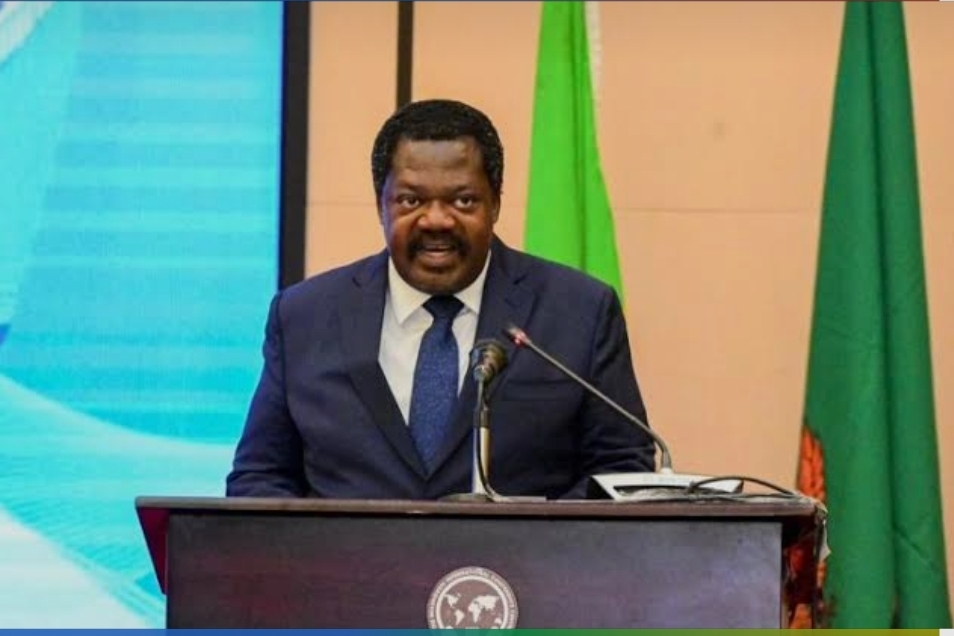
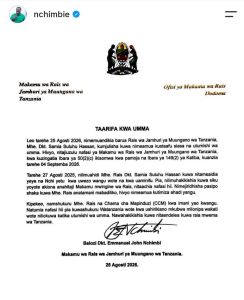
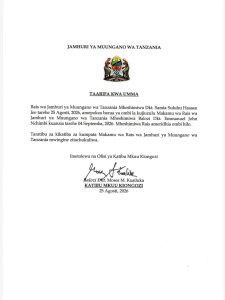
Dr Emmanuel Nchimbi has resigned as Vice-President of Tanzania. That was the story on August 25. A day later, the story became much bigger.
The ruling Chama Cha Mapinduzi has now terminated Nchimbi’s membership, saying its senior organs considered disciplinary and ethical issues surrounding him and decided that he could no longer remain a member of the party. CCM Secretary-General Dr Asha-Rose Migiro announced the decision after meetings of the party’s Central Committee and National Executive Committee. That changes almost everything.
Nchimbi’s departure can no longer comfortably be understood simply as the voluntary retirement of a Vice-President who concluded that President Samia Suluhu Hassan wanted somebody else beside her.
He has not merely left government. His party has thrown him out. And that makes the most important question even more urgent: What exactly happened between Emmanuel Nchimbi, President Samia and CCM?
On August 25, President Samia accepted Nchimbi’s resignation, which he said would take effect on September 4. He leaves less than a year after becoming Vice-President following the 2025 General Election.
In explaining his decision, Nchimbi recalled something he had told Samia before becoming her running mate: whenever she felt that she needed somebody else beside her, he would leave. He then added the sentence that immediately changed the political meaning of his resignation: He had become convinced that the President wanted change.
At first, that could have been interpreted as the language of an orderly political separation. Not anymore. CCM’s subsequent decision to terminate his membership suggests that the disagreement had gone much deeper.
The resignation may have been voluntary in constitutional form. But the expulsion makes it increasingly difficult to believe that this was simply a man peacefully retiring from politics. Something had broken. And apparently it had broken badly.
Resignation Should not Be Read Alone
Nchimbi’s exit cannot be understood by looking only at what happened this week. His political history inside CCM matters. So does the history of the party itself.
In 2015, Nchimbi was among senior CCM figures who publicly questioned the way Edward Lowassa had been eliminated from the party’s presidential nomination process. His objection was not a small matter.
CCM is a party where major disagreements are normally handled internally. Nchimbi, Sophia Simba and Adam Kimbisa publicly challenged the process. They argued that procedures had not been properly followed. That episode left a mark.
Years passed. Political circumstances changed. Nchimbi remained inside CCM. He was politically rehabilitated, rose again, became Secretary-General of the party and eventually Vice-President.
But political institutions have memories. So do political rivals. For some people inside CCM, Nchimbi never stopped being associated with that rebellious moment of 2015. This does not mean that everything that later happened to him was caused by 2015.
But when new suspicions emerged, there was already an old file in people’s minds. And now the man who survived the consequences of 2015 has finally been expelled from the party in 2026. That historical connection deserves attention.
The 2030 Question
The most important allegation surrounding Nchimbi is that some people inside CCM came to believe that he was preparing himself for the presidency in 2030.
That allegation has not been publicly proved. It must, therefore, remain an allegation. But politically, it makes sense that such a suspicion would be explosive.
Tanzania has seen this kind of succession politics before. Jakaya Kikwete contested for the CCM presidential nomination in 1995 and lost. But the political network around him did not disappear. It remained active and, over the following decade, became one of the most powerful political organisations inside CCM. Nchimbi was part of it.
By 2005, Kikwete was ready. His success taught generations of CCM politicians an important lesson: Presidential succession does not begin in the year of the election.
It begins much earlier. Networks are built. Relationships are cultivated. Political loyalty is organised. Resources are mobilised. Regional contacts are maintained. Party structures are understood. Future supporters are identified.
That is why any senior CCM politician who begins developing a visible national network can quickly become suspicious. And a Vice-President is especially vulnerable to that suspicion.
He is already one heartbeat away from the presidency. He has national visibility. He travels across the country. He interacts with ministers, MPs, regional leaders, businesspeople, religious leaders and diplomats. He does not even need to announce an ambition. Other people can announce it for him.
The allegation circulating around Nchimbi is that some senior figures concluded that he had begun building such a network for 2030. If that perception took hold, almost everything he did could be interpreted politically.
A meeting became recruitment. A friendship became an alliance. A supportive MP became part of the network. A minister close to him became a future campaigner. A wealthy supporter became a financier.
This is how succession politics works. Once people believe a network exists, even ordinary political relationships begin looking like evidence.
“I am Here To Assist, Not To Compete”
That makes something Nchimbi said before becoming Vice-President particularly interesting.
In August 2025, he publicly assured Samia that he had prepared himself to become her assistant, not her competitor. At the time, it sounded like loyalty. Today, it sounds almost prophetic.
Why did a running mate need to say publicly that he would not compete with the President? Perhaps because the suspicion already existed. Perhaps because he understood the history of CCM. Perhaps because he knew that every strong Vice-President eventually lives under the shadow of succession.
In Tanzania, the vice-presidency is both powerful and politically dangerous. The occupant must be important enough to assist the President but not so politically important that people begin imagining him as the next President.
He must be visible, but not too visible. Popular, but not too popular. Ambitious enough to perform, but not ambitious enough to frighten anybody. That is an extremely difficult balance.
Nchimbi apparently failed to maintain it – or his political opponents successfully convinced the system that he had failed. The distinction matters.
Then Nchimbi Started Speaking Differently
Whatever suspicions already existed, Nchimbi’s public statements during 2026 gave his critics more material.
In April, speaking at a symposium organised by the Mwalimu Nyerere Foundation, he warned that many leaders were using public office for personal benefit instead of serving citizens.
He spoke against abuse of power. He spoke about equality. He warned against religious and ethnic discrimination. None of that was necessarily controversial on its own.
But the political meaning of a statement depends partly on who makes it. When such criticism comes from an opposition politician, government supporters can dismiss it as opposition politics. When it comes from the Vice-President, the question becomes different: Who exactly is he talking about?
Then came July 24. Speaking at the annual meeting of the Tanzania Human Rights Defenders Coalition, Nchimbi told Tanzanians that if he had only one message for them, it would be to continue fighting for a new Constitution.
He argued that Tanzania needed a Constitution built through national agreement and capable of protecting rights, justice and dignity for generations.
He also linked peace directly to justice. There could be no sustainable peace, he said, without justice. Again, these are not strange ideas. The extraordinary thing was that they were being delivered by the Vice-President of Tanzania. And they were being delivered at a politically sensitive moment.
His remarks attracted criticism from within CCM. Some international media also noted the controversy surrounding his constitutional reform comments when reporting his resignation. With his subsequent expulsion, those speeches deserve to be reread.
Not because they necessarily constituted the offence for which he was expelled – CCM has not publicly established that connection in sufficient detail – but because they formed part of the political environment in which the relationship deteriorated.
The Constitution Was Never Just a Document
To understand why Nchimbi’s words mattered, one must understand what a new Constitution means in Tanzania.
It is not simply another law. It touches the distribution of power itself. It raises questions about presidential authority. It raises questions about elections. It raises questions about the independence of institutions. It raises questions about human rights. It raises questions about accountability.
And eventually, whether people like it or not, it can reopen the unresolved question of the political structure of the Union between Tanganyika and Zanzibar.
That is why a Vice-President calling on citizens to “fight” for a new Constitution can be interpreted in many different ways. A reformer hears encouragement. An opposition supporter hears validation. A human-rights activist hears an ally. A nervous party official may hear political positioning. And a rival thinking about 2030 may hear a campaign speech.
Nchimbi himself tried to make clear that Samia had political will for constitutional reform and that the opportunity should be used before 2030. But politically, that may not have solved the problem. It may even have deepened it.
Because by publicly placing himself at the centre of one of Tanzania’s largest unfinished political questions, Nchimbi was inevitably creating a public identity separate from the ordinary role of a Vice-President.
Was He Becoming An Alternative Centre?
This is where the question becomes more delicate. Some observers began seeing Nchimbi not simply as Samia’s deputy but as a different political voice inside the government.
He talked about justice. He talked about the Constitution. He talked about leaders abusing power. He talked about disagreement without hostility. He appeared comfortable before civil-society organisations. He spoke a language that many people outside CCM understood.
This does not prove that he was preparing a presidential campaign. But it explains why some people might have feared that he was gradually developing something more powerful than a network: a political identity.
Networks can be dismantled. Political identities are harder. And this leads to the central problem of the vice-presidency. A Vice-President who is completely invisible is politically useless. A Vice-President who becomes too visible can become politically threatening.
The Ethics Process Now Matters Much More
Before Nchimbi resigned, reports had already emerged that his difficulties had reached CCM’s internal disciplinary machinery. His resignation followed questioning before the party’s Ethics Committee. Other sources indicated that he had been referred to the committee amid growing tension inside the party.
At that stage, those reports could still be treated as part of the political background. The expulsion changes their significance. CCM has now publicly confirmed that its Central Committee and National Executive Committee considered disciplinary and ethical matters involving Nchimbi before terminating his membership.
This provides the strongest official evidence yet that the crisis was not simply between two individuals occupying the presidency and vice-presidency. It had become a party disciplinary matter.
But an important question remains unanswered. What exactly did Nchimbi do? “Ethics” is a conclusion. It is not an explanation. If a former CCM Secretary-General, presidential running mate and serving Vice-President can be expelled from the ruling party immediately after resigning from the second-highest office in the country, the public interest requires something more substantial than broad references to discipline and ethics.
Which provisions were violated? Through which actions? When? What evidence was considered? What defence did Nchimbi offer? These are not questions of gossip. They are questions of political accountability.
The Alleged Recordings
Insider accounts take the story further. According to those accounts, Nchimbi’s difficulties did not end with public speeches. They allege that information about his private political conversations and contacts had been collected over time and presented against him.
One especially serious account claims that during the party ethics process, Nchimbi was confronted with recordings of conversations in which he was said to have discussed matters considered contrary to party ethics.
These allegations have not been independently verified. That distinction remains important. There are no publicly available recordings, official minutes or sufficiently corroborated documents that allow them to be presented as established fact.
But the expulsion makes the existence and nature of the evidence considered by CCM much more important. The party has now pronounced its verdict. What it has not fully shown the public is the case behind that verdict.
If evidence eventually emerges showing that Nchimbi was secretly organising against the President or violating clearly established party rules, the interpretation of his downfall will change significantly.
If such evidence does not emerge, another question will remain: Was the real offence misconduct – or political independence?
We do not yet know. Responsible analysis must leave both possibilities open.
The Woman President Question
Another allegation circulating inside political circles is particularly sensitive. Nchimbi’s opponents are said to have repeatedly told President Samia that he did not sufficiently respect her because she is a woman.
There is no public evidence establishing this claim. It should therefore not be treated as fact. But its political importance lies elsewhere.
If such an accusation was repeatedly placed before the President, it would be extraordinarily damaging. Because it transforms ordinary disagreement into something deeply personal.
A Vice-President could challenge a policy. That can be discussed. He could disagree with advisers. That can be managed. But if the President begins believing that her deputy fundamentally does not respect her authority, the relationship becomes almost impossible to repair.
This is especially potent because Samia is Tanzania’s first female President. The question of whether male political elites fully accept female presidential authority has always existed somewhere beneath the surface of her presidency.
It is on record that, in the early days of her presidency, Samia felt compelled to make a publicly assertive statement about her own authority: standing before them, she said, was “a president whose gender happens to be female.”
The message was unmistakable: she may have been Tanzania’s first woman president, but she was president first – and her gender did not diminish the authority of the office she held.
It does not need to be true in Nchimbi’s case to be politically effective. It only needs to be believed. And some insiders say that when gender enters the equation – especially when Samia feels she is confronting male chauvinism – she becomes even more determined to assert her authority, revealing what they describe as the lioness in her.
Ndugai: The Resignation That Wasn’t Quite Voluntary
Tanzania has seen this style of political ending before. Job Ndugai was Speaker of the National Assembly. In late 2021, he publicly raised concerns about government borrowing and national debt.
His remarks generated enormous political pressure. He later apologised. Then he resigned in January 2022. Officially, it was a resignation. Politically, very few people understood it as a man simply deciding he no longer wanted to be Speaker.
Ndugai himself later described the intervention of senior political figures who advised him to step aside. His resignation became a reminder of how Tanzanian political systems often manage high-level conflict.
But Nchimbi’s case has now gone further. Ndugai resigned and remained within the political family. Nchimbi resigned – and the party expelled him. That difference is enormous.
It suggests that resignation alone was not considered sufficient to close the matter. The system did not simply want another Vice-President. CCM decided that Nchimbi himself could no longer remain inside the party.
The Jumbe Lesson
There is an even older precedent. Aboud Jumbe’s departure in 1984 remains one of the most dramatic examples of how disagreements at the top can be converted into resignation.
Jumbe was President of Zanzibar and, under the constitutional structure of the time, a Vice-President of the United Republic. His political troubles were tied to fundamental arguments about the Union.
Eventually he left power. Officially, resignation solved the institutional problem. Historically, however, we understand that resignation as the final act of a much larger political confrontation.
Nchimbi’s circumstances are completely different. But the lesson is similar. In Tanzania, resignation at the highest level sometimes tells us less about personal choice than about the point at which the political system has decided that coexistence can no longer continue.
In Nchimbi’s case, the subsequent expulsion has made that conclusion much harder to avoid.
Why Philip Mpango Was Different
Compare all this with Nchimbi’s predecessor, Dr Philip Mpango. Dr Mpango himself did not begin his vice-presidency as an entirely quiet deputy.
In his early period in office, he was notably vocal. At times, his public statements appeared to go beyond the conventional boundaries of the vice presidency. Some sounded almost like executive directives – including pronouncements touching on the hiring, firing or disciplining of officials – matters ordinarily associated with presidential authority or with officials acting explicitly under presidential instruction.
Within government circles, this reportedly caused discomfort. Mpango was quietly reminded of the boundaries of his office and subsequently became considerably more restrained in public.
That episode matters because it shows that questions about the limits of vice-presidential power did not begin with Emmanuel Nchimbi. Samia had faced something resembling this before. The difference lies in what happened next.
Mpango adjusted. Whatever tensions may have existed were contained within the system. He did not emerge as an alternative political centre. There was no sustained public narrative portraying his speeches as coded challenges to Samia, no visible political movement organising around him for the succession, and no widespread sense that State House was confronting a Vice President with ambitions of his own.
His eventual departure was therefore orderly and publicly explained. By then, Mpango had spent decades in public service – as an economist and senior government official, executive secretary of the Planning Commission, Finance Minister under President John Magufuli, and Vice President from 2021. He indicated that he wanted to retire from frontline politics, citing age, long public service and the importance of allowing a younger generation to take responsibility.
Most importantly, retirement did not turn him into an enemy of CCM. There was no immediate announcement that he had violated the party constitution or breached its ethics. He left the vice presidency without being expelled from the political establishment that had put him there.
Nchimbi’s departure has followed a strikingly different script. He did not retire. He resigned. And almost immediately afterward, CCM terminated his membership, accusing him of violating the party’s constitution and ethics. That second act changed the political meaning of the first. What might otherwise have been explained as a personal decision to leave office suddenly looked like the final stage of a much deeper rupture.
The comparison therefore becomes even more revealing. Both vice presidents, at different moments, appear to have encountered the question of where a deputy president’s authority ends and presidential authority begins. Mpango was reportedly reminded of the boundary, adjusted and remained inside the system. Whatever happened between Samia and Nchimbi ended very differently.
Mpango retired and remained within the political family. Nchimbi resigned and was expelled from it. The difference is not linguistic. It is political.
The Expulsion Destroys The “Graceful Exit” Theory
Until CCM announced its decision, it was still possible to see Nchimbi’s resignation as a compromise designed to preserve everybody’s dignity.
He would leave the vice-presidency. Samia would regain political room. CCM would avoid an open confrontation. And Nchimbi would retire quietly as a respected former Vice-President and former Secretary-General of the ruling party.
That interpretation can no longer stand comfortably. CCM did not allow the resignation to close the case. It proceeded against him anyway. That is perhaps the most revealing development of all.
If Nchimbi had already announced that he was retiring from politics and public service, what political purpose was served by terminating the membership of a man who had effectively said he was leaving politics?
There may be a straightforward disciplinary answer: the party may believe that violations of its rules must still be punished regardless of resignation.
But politically, the decision sends a much larger message. It tells CCM members that whatever Nchimbi allegedly did was serious enough that retirement was not sufficient. The party wanted a formal separation.
That transforms Nchimbi from a retired CCM elder into something politically different: a former Vice-President expelled by the party that made him Vice-President.
Now The Lowassa Question Becomes Bigger
This inevitably brings back memories of 2015. Edward Lowassa spent decades inside CCM and government. When CCM rejected his presidential ambition, he eventually moved to the opposition.
Many people who had criticised him for years suddenly saw him as a vehicle for political change. The opposition gained enormous electoral energy from his defection.
Nchimbi is not Lowassa. The circumstances are different. He has announced retirement from active politics. So far, there is no evidence that he intends to join the opposition.
But there is now one fundamental difference from yesterday: Nchimbi no longer has a CCM membership tying him to the ruling party. That changes the political possibilities around him.
He does not need to announce anything. He does not need to join anybody. He does not even need to speak. His new political identity has already been created partly for him.
Former Vice-President. Former CCM Secretary-General. Former minister. A man who publicly advocated constitutional reform. A man who said the President wanted change. And now: A man expelled by CCM.
That combination can produce political symbolism even where the individual himself does not seek it. Removing somebody from power can weaken him. Expelling him from his political home can sometimes liberate him.
2030 Has Arrived Early
The largest question therefore remains: Who succeeds Samia? The election is still years away. But Nchimbi’s downfall has effectively opened the 2030 debate.
This is the irony. If one reason people feared Nchimbi was suspicion that he was preparing too early for 2030, then removing and expelling him has made 2030 an even larger question in Tanzanian politics.
Who is the system preparing? Who does Samia trust? Who does CCM prefer? What qualities will now be considered safe in a Vice-President?
Will the party choose somebody politically strong enough to govern but weak enough not to develop an independent centre? And what lesson will ambitious CCM politicians draw from Nchimbi?
That is perhaps the most important long-term question.
For CCM, the issue is larger than Emmanuel Nchimbi. The party’s greatest historical strength has been its ability to manage internal rivalry without destroying itself.
Kikwete lost in 1995 and remained inside. He eventually became President. Nchimbi challenged the party in 2015 and survived. He eventually became its Secretary-General and the country’s Vice-President.
That capacity to forgive, absorb, recycle and reintegrate politicians has helped CCM survive longer than almost any governing party in Africa. Nchimbi’s expulsion therefore deserves examination beyond the question of whether one individual violated party ethics.
What does it tell ambitious people inside CCM? What does it tell members who disagree internally? What does it tell future Vice-Presidents? What does it tell ministers who develop independent constituencies?
A successful political party must regulate ambition. It cannot eliminate ambition. Because every political party needs people who imagine themselves becoming tomorrow’s leaders.
If independent opinion becomes rebellion, networks become conspiracy and ambition becomes disloyalty, politicians do not stop being ambitious. They simply hide their ambitions. And hidden succession politics is usually more dangerous than open succession politics.
Samia’s Problem Has Not Ended
Nchimbi’s departure solves an immediate problem for President Samia. It removes a Vice-President around whom political suspicion had accumulated. But his expulsion from CCM creates another problem.
Samia is both President of Tanzania and national chairperson of CCM. Institutionally, the government and party are separate. Politically, however, it will be difficult for the public to separate a disagreement at the top of the government from disciplinary action taken by the party the President leads.
That places a greater burden of explanation on CCM. Why did one of the country’s two highest elected leaders become unacceptable to his own party less than a year after the election? What changed? What did Nchimbi do?
The timing is particularly important. If his misconduct was serious enough to justify expulsion, when did CCM discover it? Was it before his resignation or afterward? And if the party knew earlier, why was he allowed to remain Vice-President?
These questions matter because Nchimbi was not an ordinary CCM member. He had been Secretary-General of the party, a minister, an ambassador and a senior figure within its leadership. CCM knew Emmanuel Nchimbi very well.
More importantly, the party had recently presented him to Tanzanians as suitable to serve one heartbeat away from the presidency. The Vice-President is not simply another minister. Under the Constitution, circumstances can arise in which the holder of that office succeeds to the presidency – like in Samia’s case with Magufuli.
CCM therefore made an enormously important judgement when it put Nchimbi on its presidential ticket: that he possessed the character, judgement and political suitability to potentially become President of Tanzania.
Less than a year later, the same party decided that he was no longer suitable even to remain a member.
There may be a legitimate explanation. Nchimbi may have committed serious misconduct after the election. New information may have emerged. Political trust can also collapse surprisingly quickly. But CCM needs to say what happened.
Otherwise, the questions turn back on the party itself. If the problem existed before his nomination, how did CCM’s vetting process miss it? If it developed afterward, what happened so dramatically that a man considered fit to inherit the presidency became unfit for party membership within months?
And if the real disagreement was political, another question becomes unavoidable: where does legitimate disagreement with the President end and indiscipline against the party begin?
That is why Nchimbi’s expulsion may prove more consequential than his resignation. The resignation removed an immediate problem from the presidency. The expulsion transferred part of that problem to CCM.
Nchimbi must account for whatever conduct led to his downfall. But CCM must also account for its own judgement. A party cannot tell the country that a man is fit to stand one heartbeat away from the presidency and, months later, say he is unfit even to carry its membership card – without explaining what happened in between.
And What of Nchimbi Himself?
Nchimbi may now become more politically interesting than he was as Vice-President. Paradoxically, losing office and party membership may give him something he did not possess while holding the country’s second-highest office: greater freedom to define himself politically.
Inside government, he had to speak carefully. A Vice-President cannot easily develop an independent public position without raising questions about unity at the top. Inside CCM, he was further restrained by party discipline and collective decisions. Both restraints are now disappearing.
That does not mean Nchimbi will return to active politics. He says he is retiring, and he may mean it completely. After a long career in Parliament, government, diplomacy, CCM leadership and finally the vice presidency, he may simply choose private life. But retirement means something different after expulsion. Yesterday he was a retiring CCM politician. Today he is an expelled former Vice-President. Those are not the same political identities.
But there is a cautionary precedent. When Ambassador Humphrey Polepole resigned and chose to speak publicly, little did he know that he might be setting in motion his own political demise. His experience is unlikely to encourage Nchimbi to speak out recklessly or rush into the opposition.
The memory of what happened to Polepole may instead counsel restraint. Nchimbi understands the system, its instincts and its capacity to respond to those who break ranks. But that does not make speaking out – or even eventually joining the opposition – impossible. It simply means that, if he chooses that path, he is likely to do so with his eyes open.
His next words will therefore carry unusual weight. If he speaks, people will listen for what he says about his resignation, his relationship with Samia and the reasons for his expulsion. If he remains silent, that too will invite interpretation. In a political rupture that remains insufficiently explained, what Nchimbi refuses to say may become almost as interesting as what he says.
The people around him will matter too. Who visits him? Who publicly sympathises with him? Which politicians defend his record, and which ones suddenly distance themselves? Nchimbi has spent decades building relationships across CCM, government and diplomacy. Moments of political adversity often reveal which relationships belonged to the office and which belonged to the person.
Then there is 2030. Even if Nchimbi genuinely has no presidential ambitions, perceptions already built around his name will not disappear simply because he has announced retirement. His expulsion could even strengthen, among some people, the belief that he represented an alternative political centre. CCM may have removed him from its structures without necessarily removing him from the political imagination.
That makes what CCM does next equally important. If Nchimbi goes home, remains silent and politicians associated with him continue normally within the party, this may eventually be remembered as the dramatic ending of one man’s political career. But if people perceived to belong to his network begin losing positions, facing disciplinary measures or being pushed aside, the interpretation will change. It would suggest that the issue was larger than Nchimbi himself.
That, therefore, is the next test: does CCM stop with Emmanuel Nchimbi? If it does, this may have been the removal of one man. If it does not, Tanzania may be witnessing the dismantling of a political network or potential succession project. Nchimbi says he is retiring, and perhaps he will disappear quietly. But the manner of his departure has ensured that, for now, the country will keep watching to see whether Emmanuel Nchimbi has left politics – or whether politics has simply given him a new role.
The Question We Should Really Ask
Two days ago, many Tanzanians would reasonably have asked: Why did Nchimbi resign?
After his expulsion, that question is no longer sufficient. The better question is: What did Emmanuel Nchimbi do – or what did the political system believe he was becoming – that made both his vice-presidency and his membership of CCM untenable?
Was he preparing for 2030? Was he building a rival political network? Was he becoming the face of a reformist tendency inside CCM? Was there evidence of serious violations of party ethics that the public has not yet seen? Was his constitutional reform campaign interpreted as political positioning?
Had trust between him and Samia simply collapsed beyond repair? Or did several of these things converge at once? We do not yet have enough verified evidence to choose confidently among them. And responsible analysis should resist pretending otherwise.
But we now know considerably more than we knew when the resignation was announced. Emmanuel Nchimbi entered the vice-presidency publicly promising that he would be Samia’s assistant, not her competitor.
Less than a year later, he concluded that she wanted another assistant. He resigned. President Samia accepted his resignation. And before the political dust had settled, the party he once served as Secretary-General expelled him on disciplinary and ethical grounds.
That sequence matters. Resignation could have meant separation. Expulsion means rupture. And that is why the Nchimbi story is no longer principally about a Vice-President who decided to leave office.
It is about how one of CCM’s most senior politicians moved, in less than a year, from being trusted enough to stand beside the President on the national ballot to being considered unfit to remain a member of the party.
Until CCM explains that transformation more fully – or Nchimbi eventually tells his own side of the story – the central mystery remains. Not simply: Why did Nchimbi leave? But: What happened at the very top of Tanzania’s political system that made his continued presence impossible?