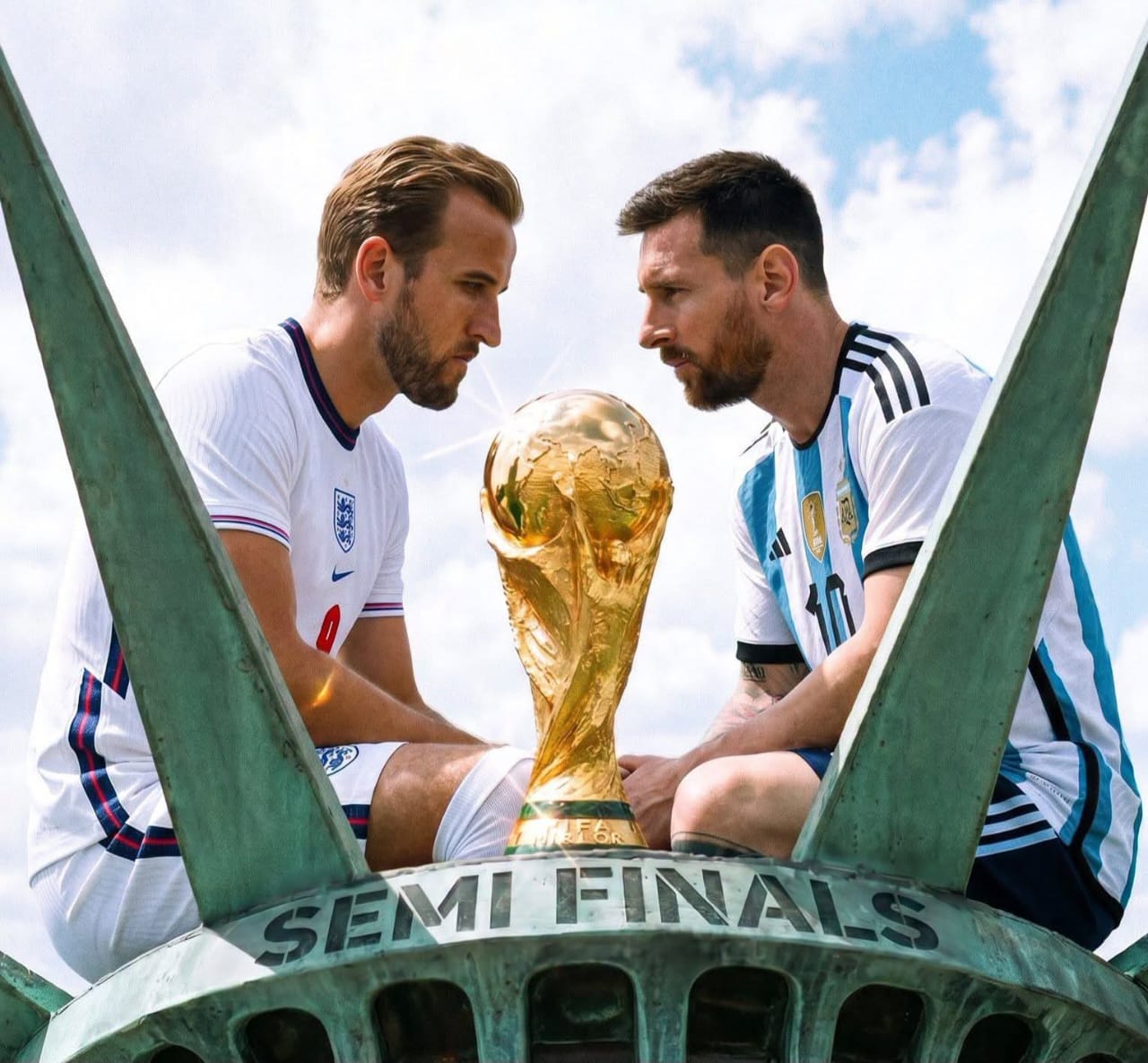
Almost eleven hours before England and Argentina meet in the second World Cup semi-final, the tournament stands on the brink of producing a final carrying far more significance than the trophy alone.
Spain have already booked their place. Their composed 2–0 victory over France last night was not merely a qualification result; it was a declaration. The European champions controlled one of the tournament’s strongest teams, restricted a French attack containing Kylian Mbappé and other elite forwards, and recorded their sixth clean sheet in seven matches. Spain have now gone 37 matches unbeaten, underlining both their consistency and their capacity to dominate major opponents.
France entered the semi-final hoping to reach a third successive World Cup final, but Spain denied them through tactical discipline, midfield control and greater collective clarity. Mikel Oyarzabal’s penalty rewarded Spain’s early authority, while Pedro Porro’s second goal followed the kind of coordinated team movement that has become characteristic of this Spanish generation. France briefly threatened late in the match, but Spain never appeared to lose control of the occasion.
That performance has created two possible World Cup finals.
An England victory tonight would produce a fascinating all-European final between Spain and England. It would bring together the continental champions and an English side seeking its first World Cup triumph since 1966.
An Argentina victory, however, would create something even more layered: Spain versus Argentina – the champions of Europe against the champions of South America, and the World Cup final functioning simultaneously as the Finalissima that football never received.
The Finalissima that failed to happen
Spain, winners of Euro 2024, and Argentina, winners of the 2024 Copa América, were supposed to meet in the 2026 Finalissima. The match was planned for 27 March 2026 at Lusail Stadium in Qatar, but the deteriorating security situation in the Middle East made the original venue unavailable. Attempts to find an alternative failed, with the parties unable to agree on another location, and the match was eventually cancelled.
Should Argentina overcome England tonight, the cancelled match would return in an extraordinary new form.
Officially, Sunday’s encounter would remain the FIFA World Cup final. It would not award a separate Finalissima trophy. Symbolically, though, it would settle precisely the question the abandoned Finalissima was created to answer: who is stronger—the champion of Europe or the champion of South America?
It would therefore become a genuine two-in-one contest: the official battle to become world champion; and the unofficial fulfilment of the missed Finalissima.
And the stakes would be immeasurably greater. Instead of meeting in a prestigious one-off intercontinental match, Spain and Argentina would face each other for the most important trophy in football.

What England bring tonight
England arrive with substantial attacking power. Harry Kane and Jude Bellingham have carried much of their scoring burden, accounting for 12 of England’s 13 goals in the tournament. Their individual quality gives England several ways of deciding a tight match: Kane through finishing and link-up play, Bellingham through late runs and physical dominance, and Bukayo Saka through width, acceleration and one-against-one ability.
Thomas Tuchel has also tried to remove the historical and political emotion from the fixture. England–Argentina carries memories of 1966, 1986, Diego Maradona, the “Hand of God,” the Falklands conflict and several heated World Cup meetings. Tuchel has insisted that England must concentrate on the present rather than allow history to consume the players.
That is sensible because England’s greatest danger may be emotional rather than technical. They must play the match, not the mythology surrounding it.
England’s physical condition is another important question. Their quarter-final against Norway placed considerable strain on the squad. Declan Rice had been affected by illness and was withdrawn at half-time, although he returned to training and is expected to be available. England will need him close to full strength because his ability to cover space, win second balls and protect the defence will be crucial against Argentina’s central combinations.
England’s best route to victory is unlikely to be a passive defensive block. They must press Argentina’s build-up selectively, attack through the wide areas and force Argentina’s midfield to defend facing its own goal. England possess the height to threaten from crosses and set pieces, but they must avoid becoming predictable by simply sending hopeful balls toward Kane.
Most importantly, England cannot allow Argentina to dictate the emotional rhythm of the game. If the match becomes slow, fragmented and full of tactical interruptions, that will probably favour the defending champions.
What Argentina bring
Argentina arrive with the greatest advantage available in international knockout football: experience of winning.
They are defending world champions, reigning Copa América champions and a team deeply familiar with pressure. They understand how to survive difficult periods, manage narrow leads and remain emotionally united when a match becomes chaotic. Their tournament has not always been effortless, but their football has repeatedly demonstrated an ability to endure what Argentinians often describe as *suffering*—absorbing pressure without losing belief.
Lionel Messi remains the symbolic and creative centre of the team. At 39, he may no longer dominate every minute through speed, but he still influences matches through positioning, passing, set pieces and his capacity to produce one decisive action. He is expected to be available despite taking a knock in the quarter-final victory over Switzerland.
England must resist the temptation to assign only one player to mark him. Messi’s intelligence makes conventional man-marking dangerous because he can drag a defender out of shape and create space for others. England will instead need collective control: one player applying pressure, another blocking the forward pass, and the defensive line remaining alert to runners around him.
Argentina’s other major advantage is their comfort in the closing stages of matches. They have repeatedly found decisive moments late in games, and they possess one of football’s most psychologically commanding goalkeepers in Emiliano Martínez. England should therefore avoid allowing the tie to drift toward penalties, where Argentina would probably feel more comfortable.

The tactical contest
The central battle will involve England’s power against Argentina’s control.
England will try to use Rice, Bellingham and their attacking runners to make the game physically intense. Argentina will seek to slow that momentum, keep possession through midfield and draw England’s press before exploiting the spaces left behind.
England’s wide players may hold the key. Argentina naturally protect the centre because that is where Messi and their midfield combinations are most influential. Saka and the opposite winger must stretch the Argentine defence, while England’s full-backs must choose carefully when to overlap. Reckless forward movement could leave spaces for Argentina to counterattack.
Argentina, meanwhile, will test England’s patience. Messi may spend periods appearing detached from the action, but England must remain concentrated. His most dangerous moment may arrive precisely when the defenders believe they have controlled him.
Set pieces could also be decisive. England have the aerial advantage, while Argentina possess greater menace from direct free kicks and second-phase situations. In a semi-final likely to be settled by fine margins, one dead-ball moment may determine the finalist.
What last night taught us
Spain’s victory over France offered tonight’s teams a clear lesson: reputation alone does not win a semi-final.
France possessed extraordinary individual talent, but Spain were superior as a functioning unit. They pressed together, defended together and moved the ball with greater purpose. England must learn from France’s failure by refusing to wait passively for their stars to rescue them.
Argentina must also take warning. Spain looked mature, balanced and extremely difficult to disrupt. Whoever reaches the final will not encounter a youthful side overwhelmed by the occasion. They will face a European champion playing with the confidence of a team that already believes it is the best in the world.
Spain did more than eliminate France. They established the standard that tonight’s winner must meet.
My projection
England have the personnel to defeat Argentina. Their youth, physical energy and attacking depth can cause serious problems, particularly if they score first. A fully fit Rice, an influential Bellingham and efficient finishing from Kane would make an English victory entirely plausible.
Yet Argentina appear better equipped for the psychological demands of this particular match. They possess greater tournament maturity, a clearer collective identity and the experience of navigating the most difficult phases of knockout football. England may have the stronger athletic profile, but Argentina have the deeper understanding of how to control the decisive moments.
I expect England to begin aggressively and perhaps enjoy the better opening period. Argentina are likely to absorb that pressure, gradually reduce England’s space and bring Messi more deeply into the match. The longer the score remains level, the more the balance should move toward Argentina.
Prediction: England 1–2 Argentina, possibly after extra time.
That result would give football the final it missed in March: Spain against Argentina, Europe against South America, Lamine Yamal’s generation against Lionel Messi’s final chapter, and the cancelled Finalissima reborn as the World Cup final.
It would not simply be another championship match.It would be two finals condensed into one historic night.