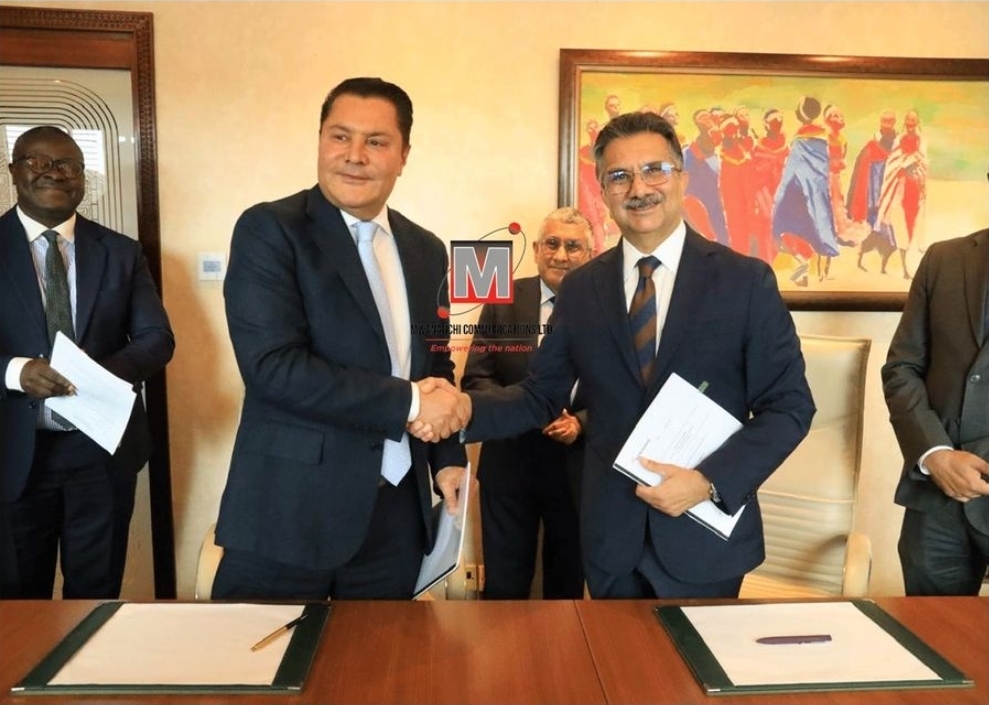
On a quiet afternoon in Nairobi today March 11, 2026, in a room filled with journalists, investors and leaders of the communications sector, Tanzanian businessman Rostam Aziz spoke to the press to announce a deal that may reshape the media landscape of East Africa.
The announcement was simple but historic. Through Taarifa Limited, an affiliate of Taifa Group, Aziz revealed that he had agreed to acquire 92,618,177 ordinary shares, representing 54.08 percent of the issued share capital of Nation Media Group – one of Africa’s most respected media institutions.
The shares were previously held by the Aga Khan Fund for Economic Development through NPRT Holdings Africa Limited. With that single transaction, a new chapter opened in the story of East Africa’s media.
But the deal was not simply about ownership. It was also about history – one that stretches back more than two decades and links Aziz with Aga Khan IV, whose development network played a defining role in building independent media across the region.
In fact, Aziz himself reminded the audience that their journey together began 26 years ago in Tanzania. At the time, he was among the founding investors of Mwananchi Communications Limited, which would later become one of Tanzania’s most influential media houses.
In 2003, Aziz personally invited the Aga Khan to invest in the company. The invitation was accepted. With the entry of the Aga Khan’s development network, Mwananchi Communications gained the stability and vision that helped it grow into a pillar of Tanzanian journalism.
A few years later, in 2006, after discussions with the Aga Khan himself, Aziz sold his shares to allow the institution to continue expanding under the Aga Khan’s long-term stewardship.
Nearly two decades later, the story has come full circle. The man who once invited the Aga Khan into Tanzania’s media sector is now acquiring the Aga Khan’s controlling stake in one of East Africa’s largest media groups. History, in this sense, has completed a remarkable loop. Yet the significance of the deal goes far beyond personal history.
For decades, the Aga Khan’s institutions helped nurture media independence in East Africa. Under his stewardship, Nation Media Group became a major voice in Kenya, Uganda, Tanzania and Rwanda, shaping public debate and strengthening democratic accountability.
Few development networks anywhere in the world have invested so consistently in journalism as the Aga Khan Development Network.
But the economic landscape of Africa is changing. Across the continent, African entrepreneurs are accumulating capital, building multinational companies and expanding their investments across borders. Increasingly, they are not just participants in global markets. They are becoming owners of the institutions that shape them.
Aziz is part of this emerging generation.
Born and raised in Igunga in Tanzania’s Tabora region, he began his career in trade and commerce before building a diverse investment portfolio spanning telecommunications, energy and infrastructure.
In 2000, he was among the early investors in Vodacom Tanzania, at a time when mobile communication was only beginning to spread across Africa. Nearly two decades later, he exited the investment in 2019 after the company had grown into one of Tanzania’s largest telecom operators.
His investments later expanded into digital connectivity through the consortium that acquired the former Tigo and Zantel operations, now operating as Yas Tanzania.
Meanwhile, his company Taifa Gas has expanded liquefied petroleum gas distribution across several African markets, including Kenya, Rwanda and Zambia.
Across East Africa, other investors have been following similar paths. Entrepreneurs like Said Salim Bakhresa of Bakhresa Group, Sudhir Ruparelia of Ruparelia Group and Vimal Shah of Bidco Africa have built business empires that operate across national borders.
Their investments in manufacturing, banking, energy and consumer goods have quietly strengthened the economic foundations of the region.
But media remains a unique sector. Unlike factories or telecom networks, media institutions shape something less tangible but equally powerful: public knowledge.
They influence how societies understand themselves, debate their future and hold power accountable. That is why Aziz’s entry into Nation Media Group carries symbolic weight.
It suggests that the future of East Africa’s storytelling—and perhaps its public conversation – may increasingly be supported by African capital.
The countries of the East African Community are already becoming more economically integrated. Trade is expanding, infrastructure is improving and businesses are increasingly operating across borders.
Capital, inevitably, follows opportunity. Seen in this broader context, Aziz’s investment is more than a business decision.
It is a signal that African investors are ready to assume greater responsibility for building and sustaining the institutions that shape their societies.
In Nairobi today, Aziz himself captured this idea in simple terms. Strong institutions, he said, are built over decades by journalists, editors, readers and investors who believe in the value of truth and public dialogue.
The responsibility of each generation is not simply to inherit those institutions, but to strengthen them for those who come after.
In East Africa, that responsibility is gradually shifting into African hands. And with this deal, a circle that began in Tanzania more than twenty years ago has quietly come to completion.