I arrived in Sweden in January 2018. Since then, I have witnessed three election campaigns, including the one now heading towards 13 September 2026. What strikes me is not only how much Swedish politics has changed, but how quietly that politics happens.
Coming from Tanzania, the contrast is remarkable. Tanzanian elections mean rallies, crowds, slogans and political arguments in buses, offices, bars and homes. Almost everybody is politically engaged. Sweden is different. There are posters, television debates and politicians campaigning in town centres, but hardly the mass-rally culture I knew.
Political conversation among ordinary people can be surprisingly subdued. Some do not vote, yet afterwards quietly complain about healthcare, prices, immigration or the direction their country has taken. But politics has consequences whether people discuss it or not.
And the Sweden voting this year is considerably different from the country I entered eight years ago. In 2018, Sweden still carried a powerful international reputation as a humanitarian country – a defender of refugees, asylum, multiculturalism and human rights. But change had already begun following the 2015 refugee crisis. The government of Prime Minister Stefan Löfven of the Social Democrats (S) tightened asylum rules and made temporary residence more common.
That history matters because Sweden’s restrictive migration turn did not begin with the present right-wing government. Governments of different political colours have progressively tightened the system.
The transformation accelerated after 2022. Prime Minister Ulf Kristersson’s Moderates (M) formed a government with the Christian Democrats (KD) and Liberals (L), supported by the nationalist Sweden Democrats (SD) through the Tidö Agreement.
When I arrived, SD was largely isolated by the established parties. Today it helps shape government policy. More importantly, ideas once associated mainly with SD – lower immigration, tougher citizenship requirements, deportations and stronger demands on foreigners – have moved towards the political mainstream.
That change has created an uncomfortable feeling among many immigrants: that legitimate concern about controlling immigration is sometimes drifting towards suspicion of immigrants themselves.
The distinction is important. Sweden has every right to decide how much immigration it can manage. But it should never allow immigration control to become discrimination against people simply because they came from somewhere else – particularly when immigrants make such an important contribution to Sweden.
Official figures from Statistics Sweden (SCB) make that contribution easier to understand. In 2025, about 1.27 million foreign-born people were actually working in Sweden. Another roughly 250,000 were actively looking for work. Altogether, about 1.52 million foreign-born people were participating in Sweden’s labour market.
There is an even more interesting statistic: almost eight out of every ten foreign-born people of working age were either working or actively seeking work, a slightly higher proportion than among Swedish-born people.
These are not insignificant numbers. Immigrants drive buses, build houses, clean offices, run businesses, care for elderly people and work in hospitals, restaurants, technology and industry. They pay taxes, spend money and contribute to the welfare system.
Yet the employment space has simultaneously become tougher. The Kristersson government – (M, KD and L, with SD support) – has raised salary requirements for labour immigrants. Since June 2026, the general work-permit threshold has been set at 90 percent of Sweden’s median salary, although shortage occupations and some skilled workers receive exemptions. The government’s stated direction is towards attracting more highly skilled labour while restricting lower-paid labour migration.
Residence itself has also become less secure for some groups. Since July, people holding residence permits based on protection can generally no longer obtain permanent residence through that route, although people who already hold permanent residence are not affected.
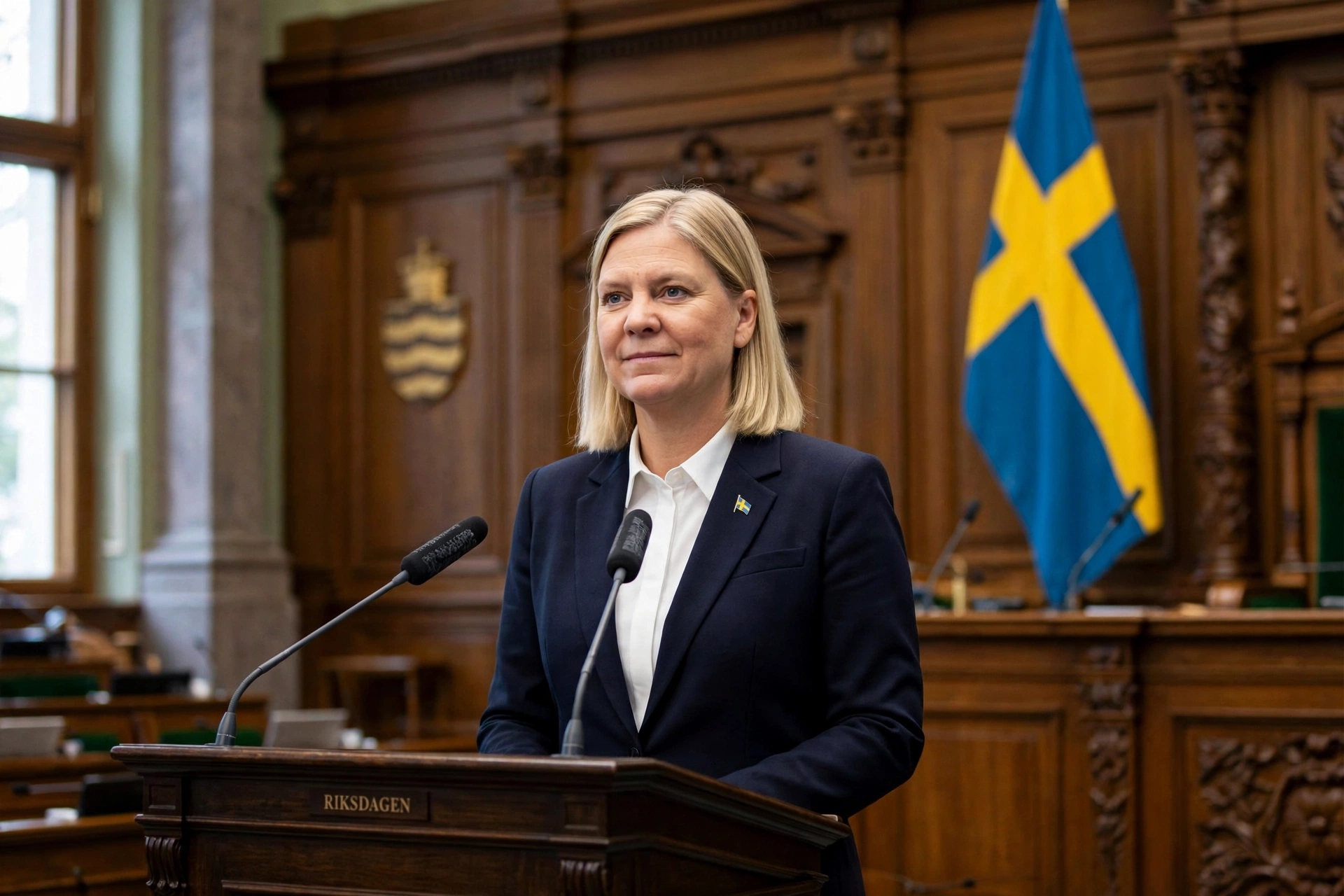
And now Sweden votes again. The Social Democrats (S) under Magdalena Andersson currently appear better positioned to lead the next government than Kristersson’s Moderates (M). One of the latest polls puts S at 31.3 percent, SD at 19.7 and M at 18.9. The opposition leads the government side by 51.3 to 46.6 percent.
But an Andersson victory would not restore the Sweden of ten years ago. The Social Democrats themselves have moved towards tougher migration policies. The difference is increasingly one of degree, priorities and political tone.
Another Kristersson government, especially one dependent on an even stronger SD, would probably push further towards restrictive migration, citizenship and return policies. An Andersson government would likely retain migration controls while placing relatively greater emphasis on integration, welfare and security for people already established here.
Sweden is already a multicultural country. Immigrants are workers, taxpayers, neighbours, parents, entrepreneurs—and Swedish citizens.
Problems of crime, unemployment and failed integration must be confronted. But Sweden should be careful that solving those problems does not evolve into discrimination against the very people helping to build and sustain the country.
Perhaps that is what strikes me most after eight years here. Swedish politics may be quieter than Tanzania’s. There may be fewer rallies and fewer heated political conversations in everyday life.
But quiet politics can produce very loud consequences. People may choose not to talk about politics. Some may even choose not to vote. But politics will still decide what kind of country they wake up in tomorrow.