How my award-winning article foretold Tanzania’s digital future, and what I never saw coming
Twenty years ago, standing at the podium of the World Summit on the Information Society (WSIS) in Geneva, award in hand, I was not the man many now casually refer to as “an award-winning journalist.”
I was simply a Tanzanian reporter wrestling with a question that bothered me deeply: “Can a nation call itself an information society when its own people are not involved in shaping it?”
That question became the spine of my 2003 article, “An Information Society Without Involvement?” This piece was inspired by the electrifying intellectual atmosphere of the Highway Africa Conference at Rhodes University in South Africa.
Under the stewardship of Prof. Guy Berger and Chris Kabwato, the Highway Africa Conference lit a fire in me. It was there, at the beginning of the 21st century, that African journalists were being provoked to think beyond newspapers and radios – to imagine digital futures we could barely define.
That inspiration pushed me to write the article that would win the Panos/GKP Media Award 2003, setting me on a professional and academic path I had never anticipated.
Winning the award opened unexpected doors. As a 2003 award winner, I also attended WSIS in Tunis, in 2005, invited both by the Highway Africa News Agency (HANA) and the United Nations.
It was the beginning of my lifelong engagement with digital cultures. Two decades later, it shaped my academic journey – culminating in a master’s thesis exploring how charitable organisations in Sweden use digital platforms to engage young people.
Today, it continues through my work with SK Media, a digital platform advancing democracy and intercultural understanding.
Yet, despite all these accomplishments, one truth remains humbling. Tanzania has grown into an information society far more rapidly, and in far more complex ways, than I ever predicted.
What I felt in 2003: Cautious hope and deep skepticism
In 2003, I wrote with optimism, but also with unease. Tanzania’s ICT policies were emerging, but public involvement was thin. I warned:
“An information society that excludes its citizens is a contradiction. Participation is not a luxury. It is the foundation of meaningful digital transformation.”
At the time, barely 1% of Tanzanians had Internet access, and mobile phones were still exclusive tools – a luxury. I feared we were building structures without people. In my opinion, we were swimming in high-level visions that bypassed ordinary Tanzanians.
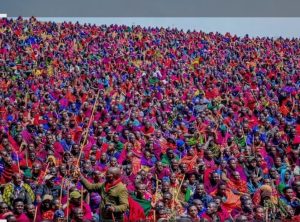
When Maasai clans protested for their land rights in Arusha two years ago, digital communication and networking was at the heart of their mobilization strategies.
Looking back, I was right about the dangers of exclusion. But I was wrong about the pace of adoption. I underestimated the ingenuity of Tanzanians, and the power of technology to slip past political and infrastructural barriers.
Tanzania 2025: A connected nation I could not have imagined
Today, Tanzania is a country where the digital wave has reached both the rural farmer in Muleba and the university student in Dar es Salaam.
Current figures tell a story I never foresaw: In 2025, Tanzania’s digital story shows an extraordinary transformation achieved in just 20 years.
According to DataReportal, the country recorded 89 million mobile connections, equal to 125% of the population, confirming that mobile phones are now central to everyday life. Internet use reached 20.6 million people (29.1% penetration), while 7.95 million social media users highlight the growing influence of digital platforms in communication and civic engagement.
Beyond usage, access infrastructure has expanded at unprecedented speed. The Tanzania Communications Regulatory Authority (TCRA) reported 56.3 million active internet subscriptions by September 2025, up from 52.9 million just three months earlier.
Over 99% of these connections are mobile, driven by widespread 4G expansion, early 5G deployment, affordable data, and rising smartphone ownership. Backed by the National ICT Broadband Backbone and the Digital Transformation Strategy (2020–2030), connectivity has accelerated mobile money, e-commerce, and online learning.
Together, DataReportal and TCRA data paint a clear picture: Tanzania has made a decisive, inclusive digital leap, emerging as one of East Africa’s fastest-growing digital societies.
In my 2003 article, I wrote:
“If Tanzania wants to leap into the information age, it must democratise access—not only in policy documents but in real lives.”
Two decades later, that access is real. Smartphones have become “schools,” “newsrooms,” and “public squares.” The youth – many of whom were not yet born when I received the WSIS award – now carry in their pockets more information than all Tanzanian libraries combined in 2003.
And they have used that information, especially in the recent 2025 elections.
President Samia Suluhu Hassan, flanked by Vice President Dr. Emmanuel Nchimbi (left) and Prime Minister Dr. Mwigulu Nchemba, moments before addressing the nation during her meeting with Dar es Salaam elders from her party recently at the Julius Nyerere International Conference Centre (JNICC) on 2 December 2025. She likened the recent protests to an attempted coup and stressed that her government would not tolerate such actions under any circumstances.
The youth’s digital power and the unsettling aftermath
In the run-up to the 2025 general election, I witnessed something historic: Gen Z demanding political accountability with an intensity Tanzania had never seen.
But this awakening came with pain. When electoral irregularities surfaced, and arbitrary arrests and abductions of activists became a norm, hundreds of young people waited for the election day and took to the streets, protesting what they believed was a stolen process. What began as peaceful demonstrations quickly escalated. Security forces responded with excessive force.
The nation that once prided itself on stability found itself shaken. Reports of casualties, arrests, and disappearances created an atmosphere we had never imagined for our country.
It is a tragedy, yet also a revelation. The same connectivity I once advocated for has empowered a generation that refuses silence.
The youth are informed. They livestream, record evidence, mobilise, and challenge authority in ways that were impossible in 2003. They have become stakeholders in the national narrative.
And this is precisely what I meant, though perhaps naïvely, in 2003 when I wrote:
“Information is not merely data; it is power. And when people finally access power, they will use it.”
Two decades later, Tanzanian youth are using that power. And the state now faces the challenge of responding in ways that must strengthen democracy rather than fracture it.
Where I was right, and where I was not
I was right that people must be at the centre of digital transformation; that technology eventually becomes political; and that the youth would redefine participation once digitally empowered.
I was wrong that Tanzania’s digital transformation would be slow, that rural areas would lag indefinitely, and that political structures could contain the impact of universal connectivity.
Apparently, I have lived long enough to watch my scepticism melt into admiration and, sometimes, fear. The information society I once imagined now walks, protests, tweets, votes, and bleeds in real time.
The journey continues
Today, as a change maker, a journalist and founder of a digital media platform, I recognise the irony. The award that began my digital journey in 2003 did more than validate my work. It reshaped my destiny.
And Tanzania’s journey continues too. We are living inside the very digital revolution that I wrote about two decades ago, and it is beautiful, chaotic, painful, and unstoppable.