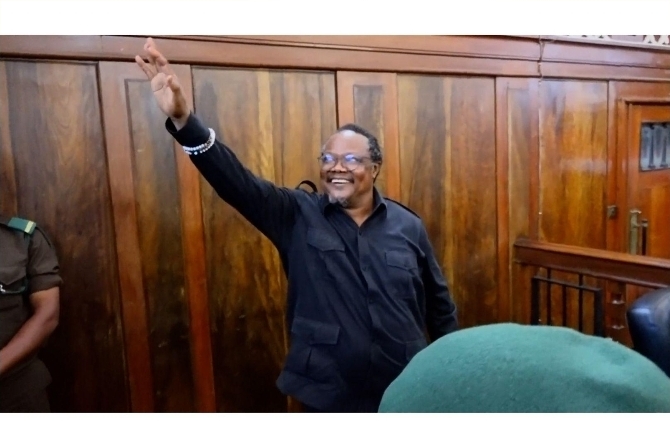
Hardly 25 hours after Tanzania’s human rights record came under examination at the United Nations in Geneva, the country’s leading opposition politician, Tundu Lissu, was sentenced to four years in prison.
The timing raises serious questions about the future of democracy, political freedom and the rule of law in Tanzania.
On 5 November 2026, Tanzania appeared before the United Nations Human Rights Council under the Universal Periodic Review (UPR), a process through which countries explain their progress in protecting human rights. The government presented its achievements, while other stakeholders and participating countries raised concerns about continuing violations.
The following day, the High Court in Dar es Salaam acquitted Lissu of treason but convicted him of incitement, an offence for which he had not originally been charged.
For many Tanzanians concerned about democracy, this was a troubling development. It also raised a fundamental question: How can Tanzania demonstrate meaningful progress in protecting political freedoms when one of its most prominent opposition leaders has been imprisoned following a campaign demanding electoral reforms?
To understand the importance of this judgment, we must revisit how the case began.
In early 2025, Lissu was leading CHADEMA’s No Reforms, No Election campaign. The party argued that Tanzania’s electoral system could not guarantee credible elections without fundamental changes.
On 9 April 2025, Lissu was arrested after addressing a series of political rallies. Prosecutors subsequently charged him with treason, alleging that his statements encouraged citizens to obstruct the October general election and threaten the government.
Lissu denied wrongdoing. He maintained that he was exercising his constitutional right to demand electoral reforms. He remained in detention as Tanzania proceeded towards the October 2025 elections without CHADEMA’s participation.
The elections were marred by protests and deadly violence. Hundreds of people were killed, with the government-appointed commission later reporting at least 518 deaths. The precise circumstances and responsibility for many of these deaths remain disputed.
These events formed the wider political background to Lissu’s trial. On 6 November 2026, a three-judge High Court panel led by Justice Dunstan Ndunguru ruled that the prosecution had failed to prove an essential element of treason.
However, the judges found that Lissu’s statements amounted to incitement under Section 390 of the Penal Code. They treated incitement as a lesser, related offence arising from the original treason charge and sentenced him to four years in prison.
The court maintained that Lissu had sufficient notice of the allegations and an opportunity to defend himself. Lissu disagreed, arguing that he had been convicted of an offence with which he had never been charged.
This legal disagreement is particularly important because it concerns the limits of a court’s authority to substitute one criminal offence for another.
Gaspar Mwanalyela, a Mwanza-based lawyer, questioned whether the High Court acted within those limits. According to Mwanalyela, the conversion of a failed treason charge into a conviction for incitement raises serious concerns about whether Lissu received a fair and impartial determination of the case brought against him.
He identifies a possible central question for an appeal: whether the High Court erred in law by convicting Lissu under Section 390 of the Penal Code when incitement was neither expressly charged nor established as a lesser, cognate offence arising from the particulars of treason under Section 39(2)(d).
This is more than a technical legal argument. A person accused of a criminal offence must know the allegations against him and have a meaningful opportunity to defend himself. Courts may, where the law permits, convict an accused person of a lesser offence. But the relationship between the original charge, the evidence and the substituted offence must satisfy the requirements of criminal procedure and a fair trial.
Mwanalyela’s argument does not, by itself, establish that the judges acted unlawfully. That is a question for appellate determination. Nevertheless, it identifies a legal issue with implications beyond Lissu’s individual case.
If the boundaries between offences are unclear, political defendants may face uncertainty about the criminal consequences of their statements, even when the original charges against them are not proved. That uncertainty could affect Tanzania’s democratic space.
During sentencing, the prosecution requested a severe punishment, arguing that it would deter Lissu and others from committing similar offences. The possible political consequences of such deterrence deserve examination.
A four-year prison sentence imposed on an opposition leader following a campaign for electoral reforms may discourage other politicians and citizens from participating in similarly confrontational political campaigns.
Some may fear that strong criticism of government decisions could expose them to criminal prosecution. Others may become more distrustful of state institutions. Neither development would help Tanzania build a confident and inclusive democracy.
This does not mean political leaders are above the law. Incitement to unlawful conduct can legitimately attract criminal sanctions when the elements of an offence are proved through fair proceedings.
But there must be a clear and predictable distinction between unlawful incitement and legitimate political expression. Citizens must be able to criticise government policies, organise opposition campaigns and demand electoral reforms without fearing punishment merely because their views challenge those in power.
This is where the events in Geneva become relevant.
During Tanzania’s Universal Periodic Review, participating countries examined concerns about political freedoms, election-related violence and accountability. The United Kingdom, for example, raised concerns about Lissu’s detention and called for independent investigations into human rights violations.
The review demonstrated that Tanzania’s international human rights commitments are being examined alongside its domestic political practices.
The judgment does not automatically establish a breach of those commitments. But it makes the need for credible safeguards particularly urgent. The immediate challenge now concerns three institutions: the judiciary, the government and the political opposition.
For the judiciary, the priority is ensuring that Lissu has meaningful access to the appellate process and that the legal questions surrounding his conviction receive careful, independent consideration.
For President Samia Suluhu Hassan’s administration, the challenge is broader. Tanzania needs meaningful electoral reforms, credible investigations into the 2025 killings and political dialogue capable of addressing longstanding disagreements.
The government has a duty to protect public order. But lasting stability requires public confidence that laws are applied fairly and political rights are respected.
For CHADEMA, Lissu’s imprisonment creates serious leadership and organisational challenges. The party must continue functioning through its institutions, developing policies and pursuing political reforms through lawful and peaceful means.
Above all, Tanzania must address the unresolved consequences of the 2025 election violence. Families who lost relatives deserve credible investigations, accountability and justice.
Lissu’s conviction cannot settle those questions. Nor can it resolve the disagreement over Tanzania’s electoral system, the independence of political institutions or the relationship between the government and opposition. These are national problems requiring national solutions.
The country must therefore decide whether political disagreement will continue producing confrontation and criminal proceedings, or whether its leaders will strengthen institutions capable of resolving disputes peacefully.
The significance of Mwanalyela’s legal argument lies partly here. If the conviction is challenged, the appellate courts will have an opportunity to clarify the limits of cognate offences and the safeguards protecting accused persons. That clarification could matter for future political prosecutions and the confidence citizens place in the criminal justice system.
Ultimately, the future of Tanzania’s democracy will not be determined by Lissu’s conviction alone. It will depend on whether the government, judiciary, opposition and wider society respond by strengthening constitutional protections, ensuring accountability and creating room for peaceful political competition.
The United Nations has heard Tanzania’s account of its human rights progress. The High Court has delivered its judgment on Lissu.
The question now is whether Tanzania will demonstrate that political disagreement can be managed through fair laws, credible institutions and democratic engagement rather than fear and confrontation.
That is the real challenge facing the country after 6 November 2026.